
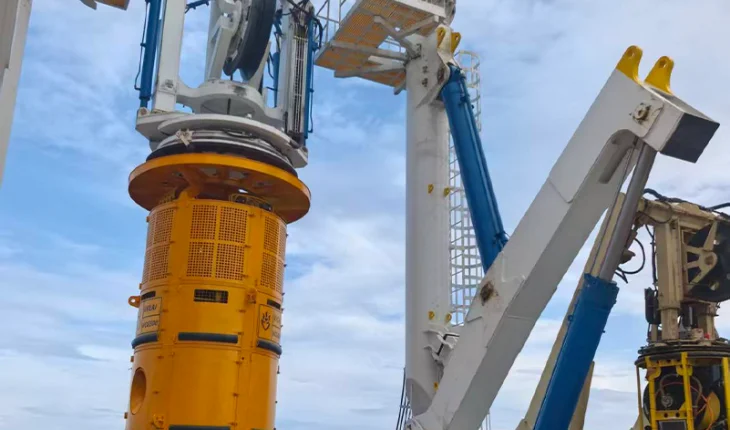
In 2025, Shandong Future Robotics successfully completed the construction of the seabed levelling project in Myanmar Waters. As a supporting project for local oil‑gas facilities, this project performed pre‑construction bed levelling and pre‑treatment works for subsea pipeline laying and subsea foundation engineering. It serves as a landmark practical project for domestic‑manufactured offshore engineering equipment to further penetrate the Southeast Asian offshore engineering market.
The seabed is dominated by silty clay and loose sand layers, with partial mixing of shell debris. Rapid seabed siltation occurs, and conventional construction equipment is prone to sinking and operational shutdown.
Strong reversing currents prevail in the area with flow velocities ranging from 0.8‑1.5 m/s. Severe flow turbulence directly impairs the accuracy and operational stability of seabed levelling operations.
Conventional construction techniques cannot accurately monitor operating conditions, imposing stringent requirements on equipment adaptive capability and construction control precision.
The project provided essential seabed preparation services for future offshore oil and gas facilities and submarine pipeline installations, laying the groundwork for subsequent marine engineering activities.
The project demonstrated the capability of domestically developed offshore equipment to operate effectively in the challenging shallow-water environments commonly found throughout Southeast Asia.
By utilizing advanced water-jet trenching technology, the project achieved efficient seabed preparation while minimizing mechanical interaction with unstable seabed materials.
To address the unique geological and environmental conditions of the project area, VVLAI deployed the VCG550 Jet Trencher as the primary operational platform.
The VCG550 utilizes a proven high-pressure water jetting system to loosen seabed sediments efficiently without relying on mechanical cutting or direct contact with the seabed. This approach significantly reduces the risk of equipment sinking or becoming immobilized in soft-bottom environments.
The system is capable of operating while suspended approximately 30–50 cm above the seabed, allowing stable and continuous operations in weak soil conditions. This non-contact working mode greatly improved operational reliability and construction efficiency.
Towed by a support vessel, the VCG550 maintained stable positioning and operational precision even under conditions of strong reciprocating currents and limited underwater visibility. The streamlined equipment design also reduced operational complexity, minimized maintenance requirements, and enhanced overall project efficiency.
The successful completion of the seabed leveling works provided a stable and properly prepared seabed foundation for future submarine pipeline installation and offshore infrastructure construction in the region.
The project validated the performance, reliability, and environmental adaptability of the VCG550 Jet Trencher in complex shallow-water offshore environments, further strengthening the competitiveness of Chinese-developed marine engineering equipment in international markets.
The project enriched VVLAI’s operational experience in Southeast Asia and provided valuable technical references for future offshore construction projects involving challenging seabed and hydrodynamic conditions.
The Myanmar Offshore Seabed Leveling Project highlights VVLAI’s expertise in offshore construction support and subsea preparation services.
Through the successful deployment of the VCG550 Jet Trencher, VVLAI delivered an efficient, safe, and reliable seabed leveling solution under demanding marine conditions. The project not only supported critical offshore energy infrastructure development but also demonstrated the growing global competitiveness of VVLAI’s advanced marine engineering technologies and equipment.
Connect with VVLAI
Explore advanced ROV systems and subsea solutions, request a consultation, or start your next offshore engineering project with VVLAI.
