
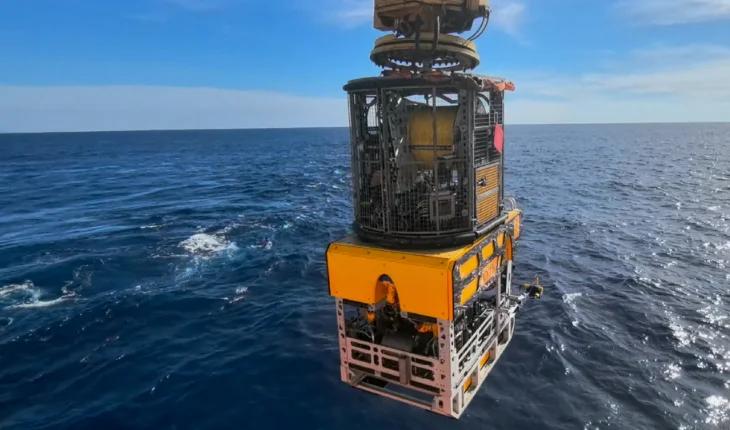
From late 2025 to February 2026, Shandong Future Robotics’ work‑class ROV VY150 was deployed to Philippine waters, successfully completing the special project of deep‑sea submarine cable fault detection, hidden hazard investigation and emergency cutting & repair.
As a critical corridor for Southeast Asia’s inter-island power grids and international communication cable networks, the waters surrounding the Philippines support essential cross-border energy transmission and telecommunications infrastructure. The primary objective of this project was to identify, inspect, and repair damaged deep-sea submarine cables while ensuring the long-term safety and reliability of these strategically important subsea networks.
This operation represents a typical open‑sea mission under complex deep‑water working conditions, compounded by a wide water‑depth range, strong current disturbances and highly variable underwater environments. These factors have significantly increased the difficulties in maintaining stable operations, achieving precise navigation and conducting accurate fault detection.
The deep-sea environment was characterized by turbid water and extremely limited visibility. Achieving reliable fault identification required advanced imaging systems, accurate positioning capabilities, and high-resolution subsea sensing technologies.
Deepwater cable maintenance and emergency intervention demand exceptional equipment performance. The project required reliable pressure resistance, real-time data transmission, operational stability, and precise intervention capabilities under extreme subsea conditions.
The project helped safeguard vital submarine cable routes supporting international communications and cross-border energy transmission across Southeast Asia.
The VY150 successfully completed precision cable-cutting operations at depths of up to 2,400 meters, demonstrating its capability to perform complex intervention tasks in ultra-deepwater environments.
The project combined fault detection, damage assessment, emergency intervention, and regional cable route inspection into a comprehensive subsea maintenance solution, improving operational efficiency and reducing response times.
Leveraging the VY150 work‑class ROV, the integrated “survey‑location‑emergency‑repair‑inspection” solution was adopted to accomplish precise submarine cable cutting and cable‑end treatment at a water depth of 2400 m. The entire process was visual and controllable. Meanwhile, a full‑domain working‑condition survey was carried out to provide data support for subsequent operation and maintenance.
Using a combination of:
-High-definition imaging systems
-Multibeam sonar technology
-Precision positioning systems
-Real-time subsea monitoring
the VY150 accurately identified damaged cable sections and pinpointed fault locations, providing critical data for subsequent repair operations.
Equipped with a professional hydraulic cutting system, the VY150 successfully performed:
-Precision cutting of damaged cable sections
-Cable end preparation and cleaning
-Separation of damaged cable segments
-Real-time visual verification of repair operations
Throughout the intervention process, high-definition video and operational data were transmitted continuously to the surface, ensuring that all repair activities remained visible, controllable, and fully traceable.
In addition to emergency repair activities, the VY150 conducted extensive subsea inspections along surrounding cable routes. This proactive assessment enabled the identification of potential risks and provided valuable information for future maintenance planning and asset management.
The successful completion of the project restored damaged deep-sea cable infrastructure and enhanced the operational security of important international communication and power transmission routes throughout Southeast Asia.
The project demonstrated the VY150’s ability to maintain high levels of precision, stability, and reliability under extreme conditions, including ultra-deepwater operations, strong currents, and limited visibility.
By successfully integrating fault detection, inspection, and intervention into a standardized operational process, VVLAI further strengthened its capabilities in rapid-response subsea maintenance and emergency repair services.
The Philippines Deep-Sea Submarine Cable Fault Detection and Emergency Repair Project represents another significant milestone in VVLAI’s international offshore operations.
Through the deployment of the VY150 Work-Class ROV, VVLAI successfully delivered a complete deepwater inspection and repair solution, ensuring the safe operation of critical submarine cable infrastructure. The project’s success further validates the performance of domestically developed deepwater ROV technology and reinforces VVLAI’s growing reputation as a trusted provider of advanced subsea engineering and maintenance solutions worldwide.
Connect with VVLAI
Explore advanced ROV systems and subsea solutions, request a consultation, or start your next offshore engineering project with VVLAI.
