
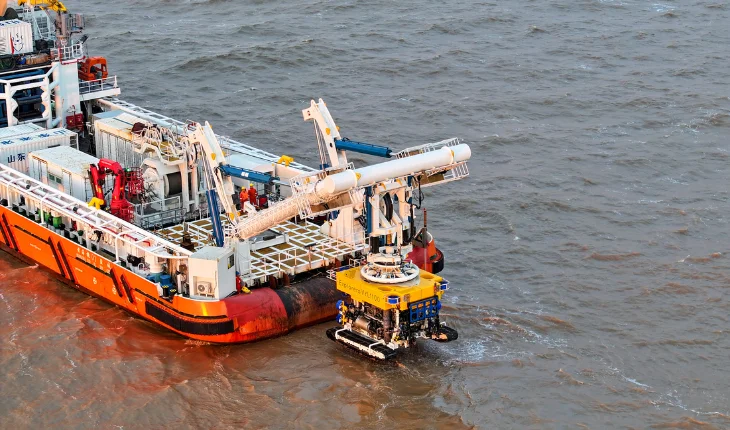
In the fall of 2024, our company undertook the submarine cable post-trenching task for the Phase I Offshore Wind Power Project in Xiangshan, Zhejiang. The goal of this project was to provide post-trenching protection for all exposed submarine cables, including sections between wind turbines, from turbines to the booster station, interconnections between booster stations, and cable crossing nodes. This ensured the safety and long-term operational stability of the entire cable route.
The project area featured challenging marine conditions with significant tidal ranges, high flow velocities, and constantly shifting currents, leading to turbulent waters. The frequent typhoon activity in autumn further limited the effective operational window, posing severe challenges for project scheduling and equipment adaptability.
The submarine cables were operational during the project, requiring high-precision construction under conditions of uninterrupted power transmission. The construction process needed to ensure uniform cable stress, avoiding mechanical disturbances that could damage insulation layers or internal structures. Additionally, stringent requirements were set for trenching depth and uniform coverage.
– Near-Turbine Operations.
– The dynamic operation of turbine blades posed collision risks to vessels and equipment.
– Mechanical operations required precision to prevent secondary damage caused by construction activities.
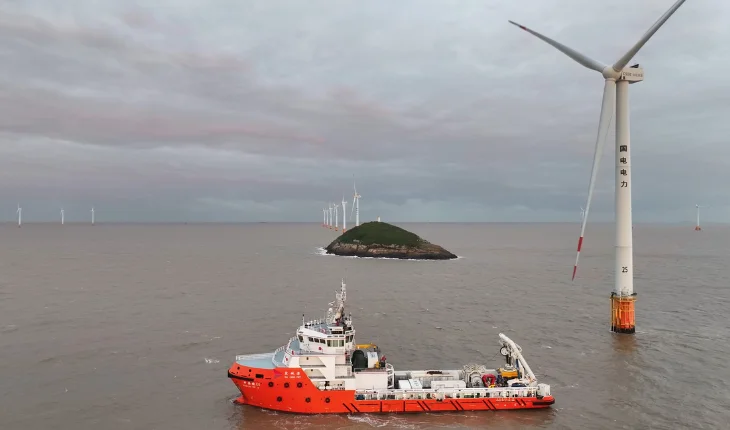
All designated submarine cable sections were successfully protected according to project specifications.
Through the use of non-contact trenching technologies, no mechanical damage to cables, joints, or crossing points occurred during construction.
All cable crossing sections achieved the required trenching depth and protection standards, with a compliance rate of 100%.
A specialized turbine coordination strategy enabled safe construction activities around operating wind turbines while maintaining project efficiency and operational integrity.
Dual-Machine Collaborative Trenching System
To address the project’s technical and environmental challenges, VVLAI deployed a dual-equipment trenching solution.
-VCG550 Trenching Machine
The VCG550 was equipped with a non-contact hydraulic jetting system and adaptive nozzle control technology.
Key benefits included:
-VYL1100 Trenching Robot
The VYL1100 was utilized for high-power trenching operations at cable crossings, joints, and critical protection zones.
Its capabilities included:
Turbine Yaw Coordination Strategy
For construction activities near wind turbines, VVLAI implemented a turbine yaw coordination method in collaboration with the project owner.
By positioning turbine blades on the leeward side during operations, construction vessels and equipment were able to work safely behind the rotor sweep area, significantly reducing operational risks while maintaining turbine stability.
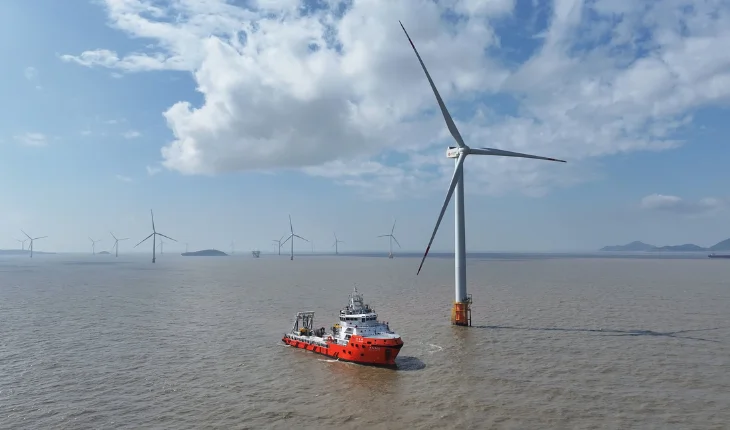
The successful completion of this project delivered several key benefits:
The project also validated VVLAI’s capability to execute large-scale offshore cable protection projects in challenging offshore environments.
The Zhejiang Xiangshan Phase I Offshore Wind Power Project represents a benchmark application of advanced submarine cable post-trenching technology in the East China Sea.
By combining innovative non-contact trenching systems, intelligent construction methodologies, and extensive offshore engineering experience, VVLAI successfully delivered a safe, efficient, and high-quality solution that met the highest industry standards.
The project not only supports the long-term reliability of offshore wind infrastructure but also provides a proven and replicable trenching solution for future offshore wind developments worldwide.
Connect with VVLAI
Explore advanced ROV systems and subsea solutions, request a consultation, or start your next offshore engineering project with VVLAI.
