
Without ROVs (Remotely Operated Vehicles), humanity’s ability to explore and develop the oceans would be significantly limited. Divers rarely operate beyond depths of 100 meters, while manned submersibles are expensive and available only in limited numbers. As one of the most important tools for underwater exploration, ROVs play an indispensable role in offshore oil and gas, offshore wind energy, marine research, defense, and underwater rescue operations.
The Origin and Evolution of ROVs
The world’s first ROV, known as “The Poodle,” was developed in 1953 by French underwater equipment and photography pioneer Dimitri Rebikoff. Based on an underwater propulsion device, The Poodle was modified into an unmanned vehicle equipped with a tether and surface control system.
During the 1960s, the U.S. Navy began using ROVs for underwater equipment recovery and salvage operations, driving further technological development. By the 1980s, more than 500 ROVs were operating worldwide, many of them serving commercial applications.
Since then, ROV technology has expanded rapidly across multiple industries. Today, tens of thousands of ROVs—including observation-class, work-class, and mini ROVs—are deployed globally for a wide range of underwater missions.
Core Components of an ROV
ROVs vary in size, configuration, and capability depending on their intended applications. However, most systems share several essential components.
Thrusters
Thrusters provide the primary propulsion and maneuvering power for an ROV.
Modern thrusters typically utilize high-efficiency brushless DC motors and vector thrust designs. Multiple thrusters are strategically positioned around the vehicle to enable six degrees of freedom, allowing the ROV to cruise, hover precisely, and navigate through complex underwater environments.
Compensator
The compensator acts as a balancing system that helps the ROV withstand deep-sea pressure and environmental disturbances.
It reduces the impact of extreme underwater pressure on internal systems while absorbing vibrations and hydrodynamic disturbances. This helps maintain stable operation of sensitive equipment such as sensors, cameras, and manipulators.
Inertial Navigation System (INS)
The INS serves as the ROV’s underwater navigation and positioning system.
By integrating high-precision gyroscopes, accelerometers, and other sensors, the INS continuously calculates the vehicle’s position, heading, and attitude. Since GPS signals cannot penetrate seawater, the INS provides reliable navigation and orientation information in underwater environments.
Underwater Lighting System
ROVs rely on industrial-grade high-intensity LED lighting to illuminate underwater work areas.
These lighting systems typically support adjustable brightness levels and multiple color temperatures, enabling effective visibility in turbid water conditions. Working together with onboard cameras, they ensure clear imaging for inspection, intervention, and survey operations.
Altimeter
An altimeter measures the vertical distance between the ROV and the seabed.
Using acoustic or ultrasonic sensing technology, it continuously monitors vehicle altitude, helping operators avoid obstacles, maintain safe operating distances, and perform precise positioning during underwater tasks.
Pan-and-Tilt Unit (PTU)
The pan-and-tilt unit acts as the visual positioning platform of the ROV.
Designed with high-torque drive systems and pressure-resistant sealing technology, it enables flexible horizontal and vertical movement of cameras and sensors. This allows operators to quickly focus on targets while maintaining stable and vibration-free observation.
HD Zoom Camera
The camera is one of the most important sensing devices on an ROV.
Equipped with high-sensitivity CMOS image sensors, modern underwater cameras support high-definition imaging, optical zoom capabilities, low-light performance, and advanced underwater image enhancement technologies. These features enable operators to capture clear and detailed visual data in challenging underwater environments.
Supporting Systems for Work-Class ROV Operations
A complete work-class ROV system requires more than just the vehicle itself. Several supporting systems work together to ensure safe, efficient, and reliable operations.
Launch and Recovery System (LARS)
The Launch and Recovery System (LARS) is responsible for deploying and retrieving the ROV from the surface vessel.
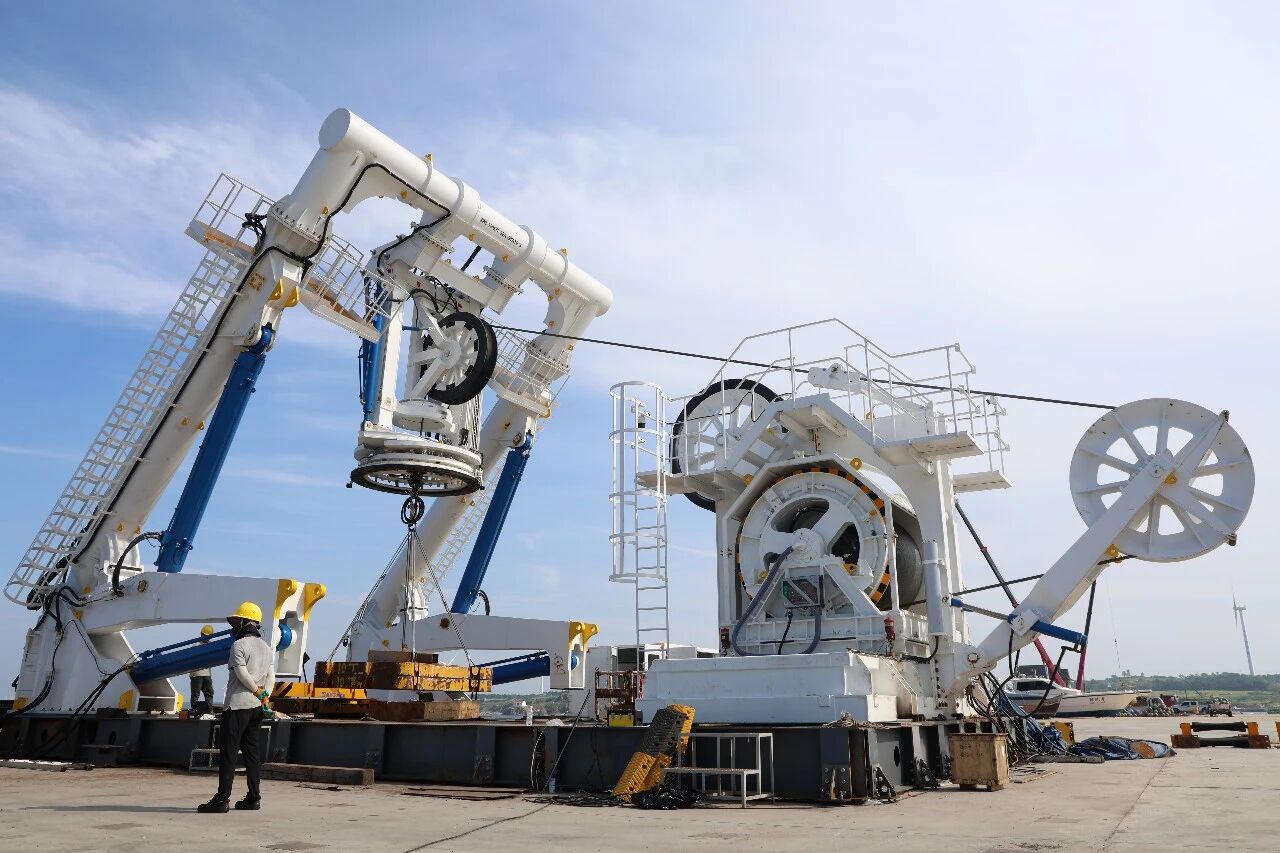
Typically consisting of an A-frame, winch system, and lifting equipment, LARS serves as the critical link between surface operations and subsea missions. It ensures the safe, stable, and efficient launch and recovery of the ROV, even in challenging offshore conditions.
Tether Management System (TMS)
The Tether Management System (TMS) manages the umbilical cable connecting the ROV to the surface control system.
Its primary functions include storing, deploying, retrieving, and protecting the tether while ensuring uninterrupted power supply and data transmission. The TMS also prevents cable entanglement, excessive bending, and mechanical damage during operations.
Control Room
The control room serves as the command center for ROV operations.
It integrates operator consoles, monitoring displays, communication systems, and data management platforms. Through the control station, operators can remotely control the vehicle, monitor mission status in real time, and coordinate complex underwater operations. Depending on mission requirements, the system can support both single-operator and multi-operator configurations.
The Growing Importance of ROV Technology
Combining advanced hardware components with sophisticated control systems, ROVs have become indispensable tools for modern underwater asset management and marine operations.
From offshore energy development and subsea infrastructure inspection to scientific research and environmental monitoring, ROV technology continues to expand the boundaries of what is possible beneath the ocean surface. As demand for deep-sea exploration and underwater engineering grows, ROVs will play an increasingly critical role in supporting the sustainable development of the global blue economy.
