
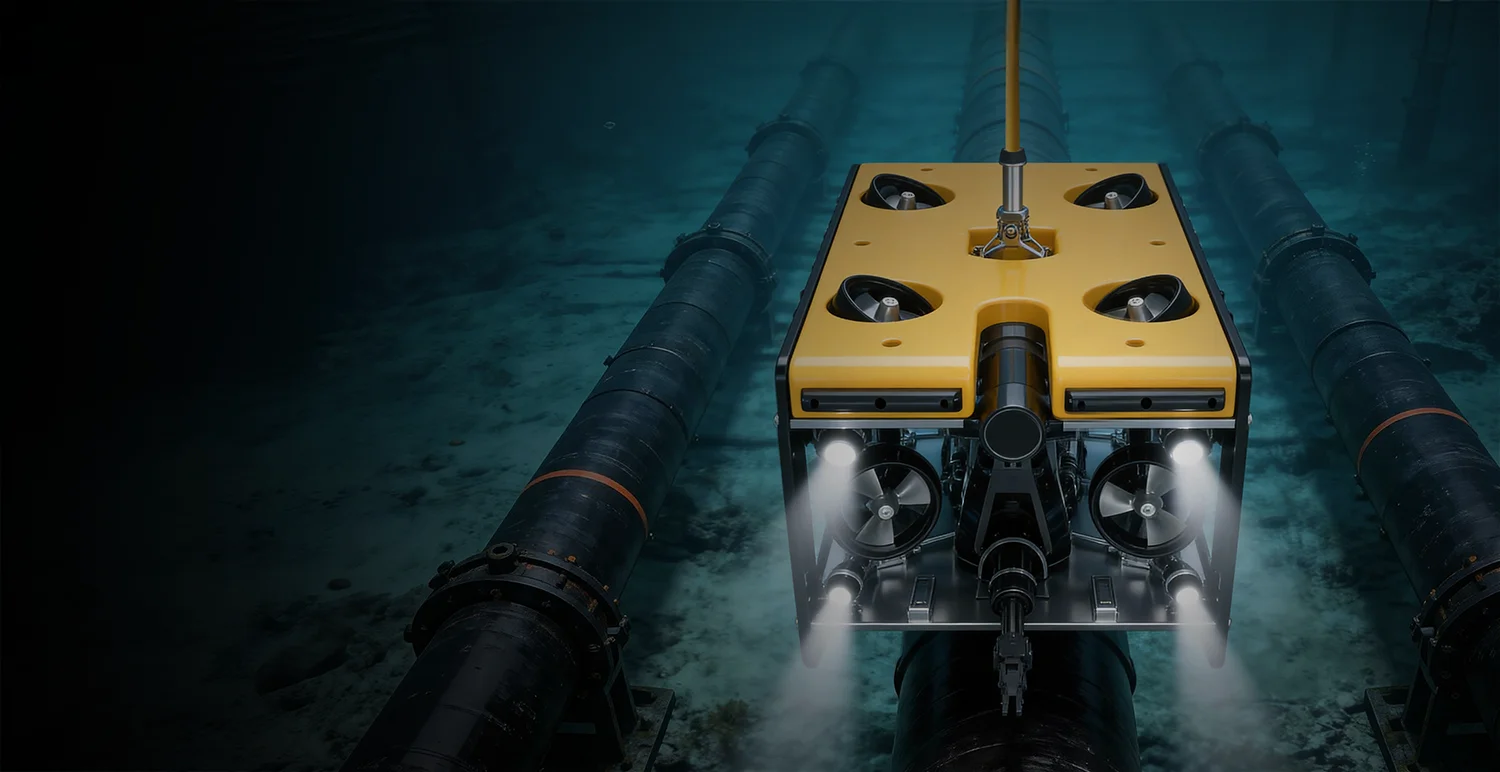
Choosing the right remotely operated vehicle is an important decision for underwater inspection, offshore construction, and subsea maintenance projects. ROVs vary considerably in size, propulsion, payload capacity, operating depth, and ability to perform physical intervention.
Two commonly discussed categories are work-class ROVs and inspection ROVs. Although both provide remote underwater access, they are designed for different operational requirements.
Understanding their differences helps offshore operators avoid over-specifying equipment for simple inspection tasks or selecting a vehicle that lacks the capability required for complex subsea work.
What Is an Inspection ROV?
An inspection ROV is primarily designed to observe and assess underwater structures, equipment, and surrounding conditions.
Typical applications include visual inspection of pipelines, dams, piers, ship hulls, underwater structures, and marine facilities. Depending on its configuration, an inspection ROV may also support sonar surveys, environmental monitoring, and basic underwater observation.
These vehicles commonly carry cameras, LED lights, depth sensors, and optional instruments.
Their compact design can make transportation, deployment, and recovery relatively straightforward. Smaller systems may be operated from workboats or other vessels without requiring the infrastructure associated with larger intervention vehicles.
However, not every inspection ROV has the same capabilities. Some are designed for simple visual observation, while more advanced systems can support additional sensors and specialized payloads.
What Is a Work-Class ROV?
A work-class ROV is designed for demanding subsea operations that require greater power, payload capacity, or intervention capability.
In addition to cameras and navigation sensors, these systems may support robotic manipulators, hydraulic tools, torque tools, and other specialized equipment.
Common applications include:
- Offshore oil and gas inspection and maintenance
- Subsea structure intervention
- Cable and pipeline operations
- Equipment handling and manipulation
- Construction support
- Recovery and emergency response tasks
Work-class ROVs typically require more extensive support systems, including a suitable launch and recovery arrangement, power supply, control equipment, and umbilical management.
Their larger operational footprint is justified when the task involves more than observation.
Key Differences Between Work-Class and Inspection ROVs
1. Primary Purpose
The most important difference is the type of work each vehicle is expected to perform.
Inspection ROVs focus on collecting underwater information. Work-class ROVs are designed to combine observation with physical intervention.
If the task involves checking corrosion, documenting structural conditions, or recording cable exposure, an inspection ROV may be sufficient.
If the task requires operating a subsea valve, handling an object, manipulating equipment, or using specialized tools, a work-class ROV may be more appropriate.
2. Payload and Tool Integration
Inspection vehicles often prioritize compactness and straightforward sensor integration. Cameras, lights, sonar, and positioning equipment are common payloads.
Work-class systems generally provide greater capacity for heavier or more power-intensive tools. Their configuration may include robotic arms, hydraulic tooling, and specialized intervention equipment.
The exact capability depends on the vehicle and its supporting systems. Buyers should evaluate payload capacity, electrical and hydraulic interfaces, and the effect of installed tools on vehicle stability.
3. Propulsion and Maneuverability
Both categories need sufficient propulsion to maintain position and move safely underwater.
Inspection ROVs may prioritize maneuverability and ease of deployment, especially in confined areas or during close visual inspection.
Work-class ROVs must balance maneuverability with the ability to resist forces generated during intervention tasks. Manipulator movement, tool operation, and surrounding currents can affect vehicle stability.
For this reason, propulsion performance should be assessed against the actual mission rather than vehicle size alone.
4. Deployment Requirements
Smaller inspection ROVs may be deployed using relatively simple launch arrangements. This can make them suitable for routine surveys and projects where vessel space is limited.
Work-class systems generally require more substantial deployment infrastructure. Umbilicals, winches, launch and recovery systems, and deck control equipment all influence mobilization planning.
For remote offshore projects, the cost of vessel time and equipment mobilization may be a significant part of the total operating budget.
5. Operating Depth
Operating depth is a separate specification from vehicle class.
An inspection ROV may be designed for shallow-water applications or rated for considerably greater depths. Likewise, work-class systems are available with different depth ratings.
The selected vehicle must meet the maximum depth requirement of the project, including the pressure ratings of its cameras, connectors, sensors, thrusters, and other components.
A deeper rating does not automatically mean that a vehicle is better suited to a particular task.
How to Choose an ROV for Pipeline Inspection
Pipeline inspection typically requires clear visual information, stable movement, and reliable positioning.
An inspection ROV may be sufficient for documenting exposed pipelines, identifying visible damage, and observing general seabed conditions.
A work-class ROV may be preferable when the project also requires intervention, object removal, tooling, or more demanding operations.
Before choosing, project teams should consider whether the task is limited to observation or includes physical work.
They should also establish the required inspection coverage, positioning accuracy, sonar capability, and data recording arrangements.
Choosing an ROV for Subsea Cable Operations
Subsea cable projects often require multiple types of underwater equipment.
Inspection ROVs can support route surveys, post-lay visual inspection, cable exposure checks, and monitoring of protection systems.
Work-class ROVs may be required for more demanding intervention tasks, depending on the operation and available tooling.
For actual trenching and burial, dedicated trenchers or trenching systems may be more suitable than an ROV alone. ROVs and trenchers can complement each other by combining inspection and intervention capabilities.
This distinction is important when planning an equipment package. A single vehicle may not be the most efficient choice for every stage of a subsea cable project.
Cost Considerations Beyond the Purchase Price
Equipment selection should account for total project cost rather than acquisition price alone.
Relevant factors include:
- Vessel and crew requirements
- Deployment and recovery time
- Maintenance and spare parts
- Tooling and sensor integration
- Operator training
- Equipment availability
- Inspection and data processing requirements
A compact inspection ROV may offer better value for routine surveys because it is easier to mobilize. However, if a project repeatedly requires physical intervention, a work-class system may reduce the need for additional equipment or separate intervention campaigns.
The right choice depends on the expected workload and the consequences of equipment limitations.
Can One ROV Handle Multiple Tasks?
Some ROVs support modular payload configurations, allowing operators to add or replace sensors and tools according to project requirements.
This flexibility can be useful for contractors working across different industries. Nevertheless, modularity has practical limits. Additional equipment affects vehicle weight, drag, power consumption, and stability.
The vehicle’s interfaces, payload capacity, and control system must be compatible with the intended tools.
A modular system should therefore be evaluated as a complete configuration rather than assuming that every available accessory can be installed simultaneously.
Conclusion
Work-class ROVs and inspection ROVs serve different but complementary roles in subsea operations.
Inspection ROVs are well suited to visual surveys, monitoring, and routine inspection. Work-class ROVs provide greater intervention capability for tasks that require manipulation, tooling, or physical interaction with underwater assets.
The best choice depends on the work scope, operating depth, payload requirements, deployment arrangements, and total project cost.
VVLAI develops ROV systems for underwater inspection, intervention, and marine engineering applications. By matching vehicle capabilities to specific operational needs, project teams can build an equipment configuration that balances efficiency, reliability, and long-term serviceability.
