
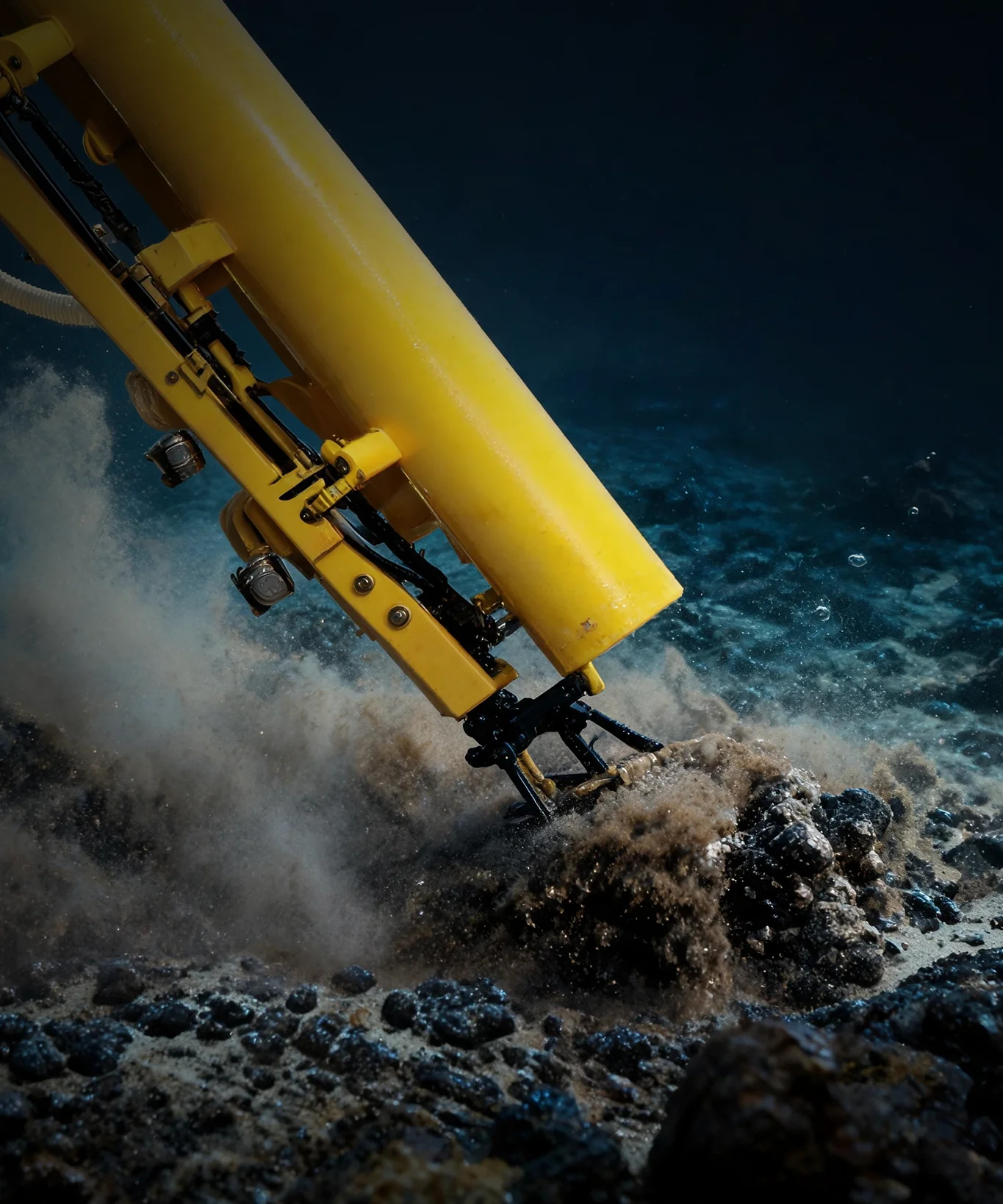
Deep-sea mineral exploration and resource development present engineering challenges that are very different from those encountered in conventional surface mining. Equipment must operate under high hydrostatic pressure, limited visibility, difficult seabed conditions, and significant logistical constraints.
Deep-sea mining robots are developed to perform selected tasks such as seabed investigation, sampling, excavation, and material collection without placing personnel directly in the underwater working environment.
Their design requires a careful balance between power, mobility, control, reliability, and maintainability. Understanding these requirements is important when evaluating robotic systems for deep-sea exploration and subsea resource projects.
Why Deep-Sea Operations Require Specialized Robots
As water depth increases, the surrounding hydrostatic pressure rises substantially. Equipment must be designed to prevent pressure-related failures in housings, connectors, sensors, hydraulic systems, and other components.
The seabed itself presents additional challenges. Sediment may range from soft mud to compacted material, while local slopes and uneven terrain can make vehicle movement difficult.
Visibility is another concern. Suspended particles and disturbed sediment can reduce camera performance, particularly during excavation or sampling.
Unlike surface equipment, deep-sea robots cannot always be accessed quickly for inspection or repair. A malfunction may require recovery to the surface, troubleshooting, and another deployment.
Reliability must therefore be considered throughout the entire equipment lifecycle.
Major Types of Deep-Sea Robotic Equipment
Deep-sea resource projects may use several categories of underwater equipment, each with a distinct purpose.
Survey and Observation ROVs
Survey ROVs collect visual and sensor data to help operators understand the underwater environment.
They may carry cameras, sonar, altimeters, depth sensors, and other instruments. Their primary purpose is observation and information collection rather than heavy excavation.
These systems can support preliminary site surveys, equipment inspection, and monitoring of underwater operations.
Drilling and Sampling Platforms
Drilling and sampling systems are used to collect geological information from the seabed.
Depending on the design, they may support coring, drilling, or other sampling techniques. The collected material helps researchers and engineers investigate sediment composition and geological conditions.
Sampling depth, core diameter, positioning accuracy, and the ability to maintain stable contact with the seabed are important design considerations.
Excavation and Mining Robots
Excavation robots are designed to disturb, collect, or move seabed material.
They may use crawler tracks, hydraulic tools, suction systems, cutting heads, or robotic arms. The appropriate configuration depends on the material being handled and the intended operation.
An excavation machine designed for soft sediment may not be suitable for compacted deposits or harder ground. Tooling and propulsion must be matched to the expected conditions.
The Importance of Hydraulic Power
Hydraulic systems are commonly used in underwater equipment that requires substantial force.
They can operate robotic arms, cutting mechanisms, excavation tools, and other actuators. A hydraulic power system can provide strong output within a compact configuration, but it must be engineered for the relevant pressure and environmental conditions.
Key considerations include:
- Hydraulic pressure and flow rate
- Actuator force and speed
- Fluid compatibility
- Pressure compensation
- Seal and hose reliability
- Heat management
- Maintenance access
Hydraulic performance should be assessed alongside the entire system. A powerful pump does not guarantee effective excavation if the cutting tool, mobility system, or material transport arrangement is inadequate.
Mobility Across the Seabed
Stable movement is essential for sampling and excavation.
Crawler-track systems can provide traction and distribute equipment weight across a larger contact area. This may be beneficial when operating on suitable soft or uneven seabeds.
However, track performance depends on sediment strength, ground pressure, slope, and machine configuration. Excessive ground pressure can cause a vehicle to sink into soft material, while insufficient traction can prevent it from climbing or maintaining position.
Some machines may incorporate skids, adjustable support structures, or other mobility arrangements to suit different operational requirements.
Engineers should evaluate the machine’s underwater weight, contact pressure, turning capability, maximum slope, and ability to recover from difficult terrain.
Excavation, Suction, and Material Handling
Mining and dredging robots often need to move material after loosening it from the seabed.
Suction-based systems can transport suitable sediment through pipes to a designated collection or discharge location. Their performance depends on pump flow, pressure, pipe diameter, particle characteristics, and the distance over which material must be transported.
Large particles, cohesive sediment, and changing material density can increase the risk of blockage or reduce transport efficiency.
Mechanical cutting and hydraulic jetting provide alternative or complementary methods of loosening seabed material.
The choice depends on the geology, desired production rate, acceptable sediment disturbance, and the project’s material handling requirements.
Sensors and Remote Control
Because operators work from the surface, underwater robots rely on sensors and control systems to provide operational feedback.
Cameras and lighting support visual observation, while sonar can provide information in low-visibility conditions. Depth sensors and altimeters help determine the vehicle’s position relative to the seabed.
Inertial navigation systems and other positioning technologies can support movement control and survey work, depending on the vehicle configuration.
Control software combines sensor information with operator commands. More advanced systems may include automated positioning functions, predefined movement sequences, and monitoring of equipment status.
For complex tasks, reliable feedback is essential. Operators need to understand not only where the machine is located but also how it is interacting with the seabed.
Designing for Maintainability
Maintenance is particularly important for equipment that operates far offshore.
Pressure testing, inspection of seals and connectors, hydraulic system checks, and verification of control functions should form part of the equipment maintenance plan.
Modular design can make it easier to replace selected components without dismantling the entire machine. Standardized interfaces may also simplify the integration of sensors and tools.
Before deployment, teams should confirm spare-part availability, recovery procedures, diagnostic capabilities, and the inspection requirements for critical components.
These measures help reduce the consequences of unexpected equipment failure.
Environmental and Operational Considerations
Deep-sea resource development raises important environmental questions.
Excavation and collection can disturb sediment, generate plumes, and affect nearby seabed habitats. The scale and duration of these effects depend on the equipment, sediment properties, operating method, and surrounding ecosystem.
Project teams should therefore evaluate environmental conditions during planning and establish suitable monitoring and operating procedures.
Robotic systems can contribute by collecting visual and sensor data, documenting operations, and supporting controlled movement. However, the use of advanced equipment does not by itself eliminate environmental impacts.
Responsible deployment requires site assessment, appropriate project authorization, monitoring, and compliance with applicable requirements.
How to Evaluate a Deep-Sea Mining Robot
A technical assessment should begin with the mission rather than a comparison of headline power ratings.
Important questions include:
- What is the required operating depth?
- What material must be sampled or excavated?
- What are the expected seabed conditions?
- Is the task primarily observation, sampling, or material collection?
- What propulsion and traction are required?
- How will collected material be transported?
- Which sensors and navigation systems are necessary?
- How will the equipment be deployed, recovered, and maintained?
The answers help establish a practical specification and reduce the risk of selecting equipment that performs well in laboratory conditions but struggles in the actual environment.
VVLAI develops underwater robotic equipment for deep-sea exploration, sampling, excavation, and related marine engineering applications. The required configuration should be determined by the project depth, seabed conditions, payload, and operational objectives.
Conclusion
Deep-sea mining robots combine mechanical engineering, hydraulic power, subsea electronics, remote control, and specialized material handling.
Their performance depends on how these systems work together under real operating conditions. Mobility, excavation capability, sensor integration, pressure resistance, and maintainability are all essential considerations.
As subsea exploration technologies develop, carefully engineered robotic systems will remain important tools for geological investigation and underwater resource projects.
Successful equipment selection begins with a clear understanding of the seabed, the task, and the practical limitations of the operating environment.
