
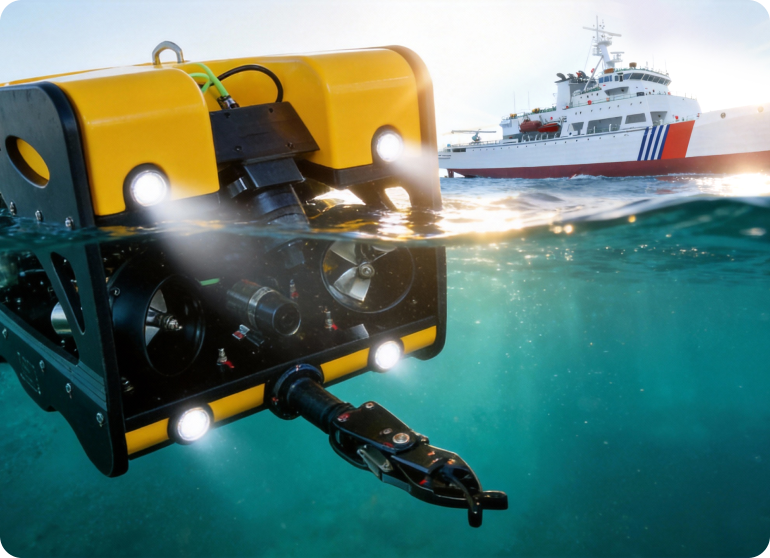
The rapid expansion of offshore wind power has increased the demand for reliable subsea inspection and maintenance services. Beneath every offshore wind farm, a network of foundations, submarine cables, connectors, and other underwater structures must remain in good condition throughout the project lifecycle. Even minor damage to these components can lead to costly repairs, power transmission interruptions, or unexpected operational downtime.
Traditional inspection methods often require divers or specialized support vessels. However, as offshore wind farms move into deeper waters and farther from shore, these approaches become more expensive and operationally challenging. Remotely operated vehicles (ROVs) provide an alternative by allowing operators to inspect underwater infrastructure without placing divers directly in hazardous environments.
Why Subsea Inspection Matters for Offshore Wind Farms
An offshore wind farm operates in a demanding marine environment. Seawater corrosion, tidal currents, sediment movement, and seabed changes can gradually affect underwater infrastructure.
Subsea inspection is particularly important for several components.
1. Submarine power cables
Submarine cables connect individual wind turbines to offshore substations and transmit electricity to the mainland grid. Their condition can be affected by seabed erosion, external impacts, excessive bending, and inadequate burial depth. Regular inspection helps identify exposed cable sections, damaged protection systems, and potential free spans.
2. Offshore foundations
Monopiles, jackets, and other foundation structures are exposed to continuous hydrodynamic loading. Inspections can identify corrosion, marine growth, structural damage, and changes around the foundation caused by seabed scour.
3. Cable protection systems
Rock placement, mattresses, concrete protection units, and other cable protection systems may shift or become damaged over time. ROV inspections help operators evaluate whether these protective structures remain in their intended positions.
4. Subsea connections
Cable entry points, connectors, and transition areas require careful monitoring. These locations can experience mechanical stress and are often more difficult to inspect using conventional methods.
How ROVs Support Offshore Wind Farm Inspections
An ROV is connected to a surface control system through an umbilical cable. Operators can control its movement, monitor live camera feeds, and use onboard instruments to examine underwater structures.
For offshore wind farm subsea inspection, an ROV can perform several tasks.
Visual Inspection of Subsea Infrastructure
High-definition underwater cameras provide real-time images of cables, foundations, connectors, and protection systems. Operators can move the vehicle close to a target area to examine visible defects, marine growth, or changes in the surrounding seabed.
Lighting systems are equally important because underwater visibility decreases significantly with depth and suspended sediment.
Sonar-Assisted Inspection
Visibility can be limited by turbidity, sediment disturbance, or low-light conditions. Imaging sonar helps operators locate underwater structures and maintain situational awareness when camera-based inspection becomes less effective.
Combining cameras and sonar allows inspection teams to work in a wider range of underwater environments.
Cable Route Monitoring
ROVs can follow submarine cable routes to check burial conditions and identify exposed sections. This is particularly useful after severe weather, seabed movement, or nearby marine construction activities.
Inspection data can also help engineers compare the current cable condition with previous survey records.
Inspection in Challenging Water Conditions
Offshore wind farms may be located in areas with strong currents, complex seabed topography, or limited visibility. Work-class and inspection-class ROVs can be selected according to operating depth, required equipment, and inspection objectives.
The choice of vehicle should consider more than depth rating. Maneuverability, propulsion performance, camera configuration, sonar compatibility, and tether management all influence inspection efficiency.
Selecting the Right ROV for Offshore Wind Projects
Different inspection tasks require different ROV configurations. A compact inspection ROV may be sufficient for routine visual checks, while a larger work-class ROV may be necessary when the operation involves additional sensors, tooling, or intervention equipment.
Important selection factors include:
- Operating depth: The ROV must meet the project’s maximum working depth, with an appropriate operational margin.
- Positioning and stability: Reliable maneuvering is essential when inspecting cables and structures close to the seabed.
- Imaging equipment: Cameras, lighting, and sonar should match the expected visibility conditions.
- Payload capacity: Additional sensors or tools may increase the vehicle’s weight and power requirements.
- Tether management: The umbilical system should support the planned operating distance and vessel configuration.
- Maintenance and support: Equipment availability, spare parts, and technical support affect long-term operating costs.
- For projects involving cable repair, protection installation, or other physical intervention, inspection capability alone may not be sufficient. A work-class ROV with suitable manipulators and tooling may be more appropriate.
From Inspection Data to Preventive Maintenance
The value of an ROV inspection extends beyond collecting underwater images. Properly recorded inspection data helps asset owners understand how their infrastructure changes over time.
A useful inspection report should include the location of each finding, visual evidence, relevant sonar information, and a description of the observed condition. Where possible, inspection records should be compared with previous surveys to identify developing problems.
This approach supports condition-based maintenance rather than relying exclusively on fixed inspection intervals.
For example, an exposed submarine cable section may require additional monitoring or burial protection. A damaged cable mattress may need repositioning. Early identification gives project operators more time to plan maintenance work before a minor issue becomes a major failure.
Supporting Reliable Offshore Wind Operations
As offshore wind farms become larger and more geographically dispersed, subsea inspection will remain an important part of asset management. ROV technology provides operators with a flexible way to inspect underwater infrastructure, collect detailed condition data, and reduce dependence on diver-based operations.
VVLAI develops underwater robotic systems for subsea inspection and marine engineering applications. With different ROV configurations and supporting underwater equipment, project teams can select solutions according to operating depth, inspection requirements, and site conditions.
Reliable inspection begins with choosing equipment that matches the actual underwater task. By combining suitable ROV platforms, imaging systems, and operational planning, offshore wind operators can improve inspection efficiency and support the long-term reliability of subsea infrastructure.
