
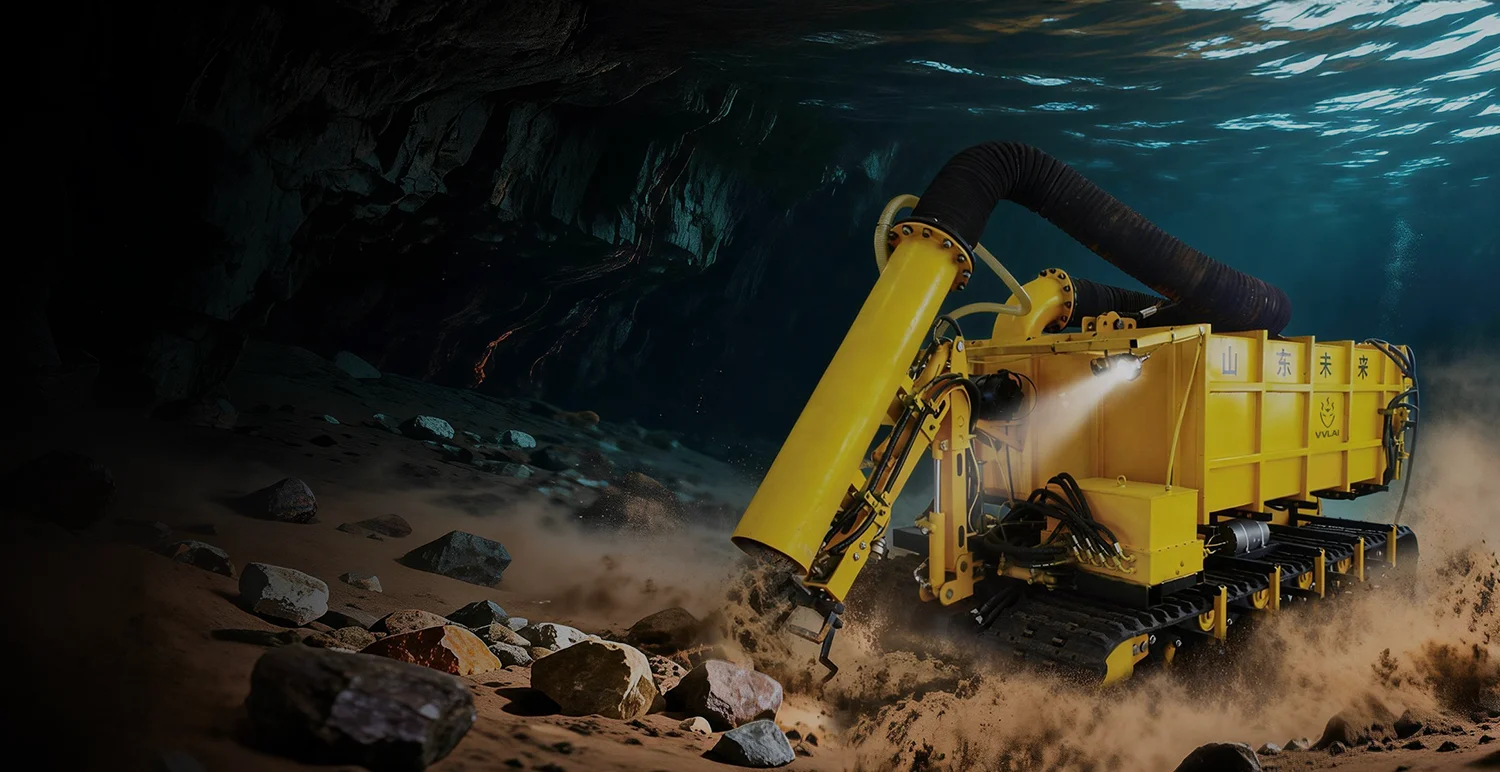
Sediment accumulation is a common challenge in ports, reservoirs, waterways, offshore construction sites, and other underwater environments. Over time, sand, silt, mud, and other deposited materials can reduce water depth, obstruct navigation channels, affect infrastructure, and interfere with engineering operations.
Traditional dredging methods often rely on large surface vessels and mechanical equipment. While these systems are effective for many projects, they may be difficult to deploy in confined areas or locations where precise underwater excavation is required.
An underwater dredging robot provides another approach. By bringing excavation and sediment removal equipment closer to the seabed, it can support targeted dredging operations in areas that require remote control and specialized maneuverability.
What Is an Underwater Dredging Robot?
An underwater dredging robot is a remotely operated or controlled subsea machine designed to loosen, collect, and transport sediment from the seabed.
Depending on its design, the system may use hydraulic pumps, suction heads, mechanical cutting tools, or other excavation equipment.
A typical system includes:
- Underwater vehicle platform
- Propulsion or movement system
- Dredging or excavation equipment
- Sediment suction and discharge system
- Hydraulic or electrical power unit
- Cameras and underwater lighting
- Control and monitoring system
Some systems are self-propelled, while others operate with support from a surface vessel or external equipment.
The appropriate configuration depends on the sediment type, required removal volume, operating depth, and project layout.
Where Are Underwater Dredging Robots Used?
Underwater dredging robots can support different types of sediment removal projects.
1. Port and Harbor Maintenance
Ports and harbors experience continuous sediment accumulation due to tides, river discharge, waves, and vessel activity.
If sediment levels increase beyond the permitted operating range, navigation channels and berthing areas may become too shallow for certain vessels.
Dredging robots can support localized sediment removal, particularly in areas where conventional dredging equipment has limited access.
2. Reservoir Sediment Removal
Reservoirs gradually accumulate sediment carried by rivers and surrounding runoff.
Excessive deposition can reduce effective storage capacity and affect water management operations.
Underwater dredging equipment can be used to remove accumulated material from selected areas without requiring the entire reservoir to be drained.
Actual feasibility depends on water depth, sediment properties, environmental restrictions, and discharge arrangements.
3. Marine Construction Sites
Offshore and coastal construction projects may require seabed preparation before foundations, cables, pipelines, or other infrastructure can be installed.
Sediment removal may be necessary to create a suitable working surface or clear material from a designated construction area.
A remotely operated dredging system can support targeted excavation where underwater access is limited.
4. Underwater Infrastructure Maintenance
Sediment can accumulate around pipelines, intake structures, drainage outlets, and other submerged facilities.
If deposits interfere with equipment access or system performance, localized dredging may be required.
An underwater dredging robot can be configured to work close to these structures, provided the excavation method and operating parameters are compatible with the infrastructure.
How Does an Underwater Dredging Robot Work?
The working process varies depending on the equipment configuration, but most systems follow several basic stages.
Step 1: Positioning the Vehicle
The robot is deployed from a suitable support vessel or launch platform.
Using cameras, sonar, and other positioning equipment, operators guide the vehicle toward the target dredging area.
Stable positioning is important because excessive movement can reduce excavation accuracy and disturb nearby sediment.
Step 2: Loosening the Sediment
Once the vehicle reaches the work area, the excavation system begins disturbing the seabed material.
Different tools are suitable for different sediment conditions.
For example, hydraulic jets can loosen softer deposits, while mechanical cutting systems may be needed for compacted sediment.
The method should be selected according to the material’s density, cohesion, and particle characteristics.
Step 3: Collecting and Transporting Material
After the sediment is loosened, it can be collected through a suction system or another material-handling mechanism.
Pumps transport the sediment-water mixture through discharge pipelines to a designated location.
The discharge system must be designed according to particle size, transport distance, flow requirements, and the characteristics of the material being removed.
Step 4: Monitoring the Dredging Process
Operators monitor the vehicle’s position, excavation progress, and equipment condition during operation.
Cameras provide visual information, while sonar and other sensors can help assess the underwater environment.
For projects requiring specific excavation dimensions, additional survey data may be needed to verify the final seabed profile.
Key Factors That Affect Dredging Performance
The performance of an underwater dredging robot depends on the interaction between the vehicle, excavation system, sediment, and operating environment.
Sediment Type
Sand, silt, clay, gravel, and compacted deposits behave differently during excavation.
Fine sediment may be relatively easy to suction but can remain suspended in the water for longer periods. Coarser material may require larger passages and more robust handling equipment.
Highly cohesive clay can be difficult to remove using suction alone and may require mechanical loosening.
Pump Capacity
Pump capacity influences how much sediment-water mixture can be transported through the discharge system.
However, a larger pump does not necessarily guarantee higher production. The actual output also depends on sediment concentration, pipeline diameter, transport distance, and resistance within the system.
Excavation Width and Depth
The required working dimensions determine the appropriate vehicle size and tool configuration.
A project involving shallow localized cleaning may require a different machine from one involving deep excavation over a large seabed area.
Vehicle Mobility
The robot must move effectively across the seabed while maintaining stable contact with the working surface.
Crawler tracks, skid systems, and other mobility configurations offer different levels of traction and maneuverability.
Soft sediment, uneven terrain, and underwater slopes should all be considered during equipment selection.
Underwater Visibility
Dredging often generates suspended sediment, which can significantly reduce camera visibility.
Sonar-assisted navigation and appropriate sensor configurations can help operators maintain awareness when visual conditions deteriorate.
Underwater Dredging Robots vs. Conventional Dredging Equipment
Conventional dredging vessels remain suitable for many large-scale projects, especially when high-volume sediment removal is required over broad areas.
Underwater dredging robots offer a different set of capabilities.
| Comparison | Underwater Dredging Robot | Conventional Dredging Equipment |
| Operation | Remote subsea operation | Primarily vessel-based |
| Working area | Can support targeted underwater tasks | Often suited to larger dredging areas |
| Access | Useful in certain confined or difficult-to-reach locations | Depends on vessel size and site access |
| Positioning | Controlled near the seabed | Depends on dredger configuration |
| Excavation method | Can use specialized subsea tools | Commonly uses mechanical or suction dredging systems |
| Deployment | Requires suitable launch and support arrangements | Requires dredging vessel mobilization |
Neither solution is universally better. Project teams should compare equipment based on excavation volume, sediment conditions, access restrictions, water depth, environmental requirements, and total operating costs.
Environmental Considerations During Underwater Dredging
Dredging can affect the surrounding underwater environment, particularly when fine sediment becomes suspended in the water column.
Before beginning work, contractors should evaluate:
- Expected sediment disturbance
- Water turbidity limits
- Potential impact on nearby habitats
- Sediment contamination risks
- Discharge location and material treatment requirements
- Applicable environmental permits
Monitoring during operation helps ensure that sediment removal remains within the project’s environmental requirements.
In sensitive areas, excavation methods and operating procedures may need to be adjusted to reduce unnecessary disturbance.
Choosing the Right Underwater Dredging Robot
A suitable dredging system should be selected according to the actual requirements of the project.
Before equipment deployment, contractors should confirm the sediment composition, required excavation dimensions, water depth, target production rate, discharge distance, and available support vessel.
It is also important to evaluate whether the vehicle can maintain stable operation under the expected seabed conditions.
VVLAI develops underwater robotic equipment for subsea engineering and marine construction applications. For projects involving underwater excavation and sediment removal, equipment configuration should be matched to the site conditions and operational objectives.
Conclusion
Underwater dredging is not a one-size-fits-all operation. Different sediment types, water depths, access conditions, and excavation requirements call for different equipment configurations.
An underwater dredging robot can provide a practical solution for targeted sediment removal and remote subsea excavation, especially when conventional methods face access or positioning limitations.
With appropriate excavation tools, pumping capacity, vehicle mobility, and monitoring systems, robotic dredging equipment can support more controlled underwater operations across ports, reservoirs, marine construction sites, and subsea infrastructure projects.
