
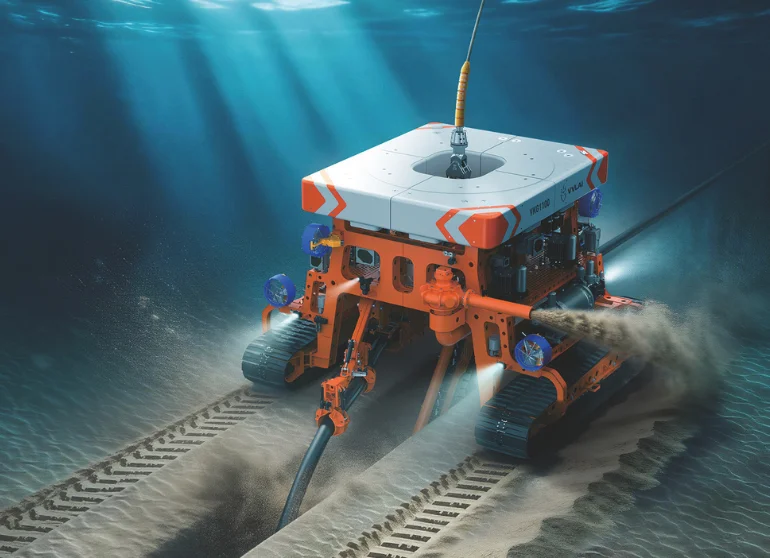
Subsea infrastructure plays an essential role in offshore energy, marine transportation, telecommunications, and underwater construction. Submarine pipelines, cables, offshore foundations, and subsea equipment operate in environments where direct inspection is difficult. Over time, corrosion, sediment movement, marine growth, and external impacts can affect their condition.
Regular underwater inspection helps operators identify potential problems before they develop into costly equipment failures. However, traditional diver-based inspections have limitations, particularly in deepwater environments and locations with strong currents or poor visibility. An underwater inspection robot provides a remote inspection solution that allows operators to examine submerged structures while reducing the need for direct human intervention.
What Is an Underwater Inspection Robot?
An underwater inspection robot is a remotely operated vehicle designed to collect visual and environmental information from underwater locations. Most systems use cameras, lighting equipment, and optional sensors to help operators inspect subsea structures.
Depending on the application, an underwater inspection robot may be equipped with:
- High-definition underwater cameras
- LED lighting systems
- Imaging sonar
- Depth and altitude sensors
- Positioning and navigation equipment
- Inspection and measurement instruments
- Communication and control systems
Compact inspection ROVs are commonly used for visual surveys and routine underwater observations. Larger work-class ROVs can accommodate additional payloads and specialized equipment for more demanding subsea operations.
The appropriate system depends on the operating depth, inspection target, environmental conditions, and required data quality.
Key Applications of Underwater Inspection Robots
Underwater inspection robots are used across several industries. Their ability to operate remotely makes them suitable for inspecting structures that are difficult or inefficient to access manually.
1. Submarine Pipeline Inspection
Submarine pipelines transport oil, gas, and other fluids between offshore facilities and onshore infrastructure. These pipelines are exposed to corrosion, seabed movement, external impacts, and changing environmental loads.
An underwater inspection robot can follow a pipeline route and collect visual information about its external condition. Operators can check for visible corrosion, damaged coatings, exposed sections, free spans, and nearby debris.
When visibility is limited, sonar can help locate the pipeline and maintain awareness of the surrounding seabed.
Regular inspections provide useful information for pipeline integrity management and maintenance planning.
2. Submarine Cable Inspection
Submarine power and communication cables are essential for offshore wind farms, telecommunications networks, and cross-border energy transmission.
An inspection ROV can follow a cable route to identify exposed sections, damaged protection systems, and possible external interference. It can also inspect cable crossings and connection areas where mechanical stress may be more significant.
Inspection records help operators evaluate cable conditions and determine whether additional protection or maintenance is required.
3. Offshore Platform Inspection
Offshore platforms contain underwater foundations, structural members, connectors, and other submerged components.
An underwater inspection robot can examine these structures for visible damage, corrosion, marine growth, and changes in the surrounding seabed.
Compared with inspections conducted entirely from the surface, an ROV provides a closer view of underwater components and can access areas that are difficult to inspect from a vessel.
4. Port and Harbor Infrastructure Inspection
Ports and harbors contain submerged structures such as quay walls, bridge foundations, piles, and underwater pipelines.
An inspection robot can help operators examine structural surfaces, identify visible defects, and assess underwater conditions without relying exclusively on divers.
This is particularly useful for routine inspections and preliminary condition assessments.
How ROV Technology Improves Inspection Efficiency
An ROV is controlled from a surface station through an umbilical cable. Operators use live camera feeds and sensor information to guide the vehicle toward inspection targets.
Several features contribute to inspection efficiency.
Remote operation: Operators can conduct underwater observations from a support vessel or suitable control location, reducing the need for divers to work directly at the inspection site.
Real-time visual feedback: Underwater cameras provide immediate images of the target structure, allowing operators to adjust the vehicle’s position and viewing angle.
Sonar-assisted navigation: Imaging sonar can support navigation and target identification when suspended sediment or low-light conditions reduce camera visibility.
Flexible deployment: Different ROV sizes and configurations can be selected for shallow-water inspections, confined environments, or deeper offshore operations.
Repeatable inspection routes: With suitable positioning and operational records, inspection teams can revisit the same locations and compare changes over time.
Camera Inspection vs. Sonar Inspection
Camera systems and sonar serve different purposes in underwater inspection.
Cameras provide detailed visual information about surface conditions, visible damage, and the appearance of underwater structures. They are especially useful when water clarity is sufficient.
Sonar uses acoustic signals to detect objects and surrounding structures. It can be valuable in turbid water, where optical visibility is poor.
For many subsea inspection projects, combining cameras and sonar provides more reliable situational awareness than relying on either system alone.
The sensor configuration should be selected according to the expected underwater conditions and the inspection objectives.
How to Choose the Right Underwater Inspection Robot
Selecting an inspection ROV requires an understanding of the actual working environment.
Operating depth: The vehicle must have an appropriate depth rating for the project. Other connected components, including cameras and sensors, should also meet the required depth specifications.
Propulsion performance: The ROV should maintain stable movement in the expected current conditions and around the inspection target.
Imaging capability: Camera resolution, lighting coverage, and viewing angles influence the quality of inspection data.
Navigation and positioning: Accurate positioning is important when following long cable or pipeline routes and revisiting specific inspection points.
Payload compatibility: Some projects require additional sonar, measurement instruments, or specialized sensors. The vehicle should have sufficient payload capacity and system compatibility.
Maintenance and technical support: Long-term equipment reliability depends on serviceability, spare parts, and access to technical assistance.
Supporting Long-Term Subsea Asset Management
An underwater inspection robot is not simply a camera platform. It is part of a broader subsea asset management process.
Inspection data should be recorded systematically, with relevant information about the inspection location, operating conditions, observed defects, and recommended follow-up actions.
Comparing current inspection results with previous records helps engineers identify changes in asset condition and prioritize maintenance activities.
VVLAI develops ROV systems for underwater inspection and subsea engineering applications. Its product range includes inspection-class and work-class configurations designed for different operational requirements.
By selecting suitable underwater robotic equipment and inspection instruments, offshore operators can improve access to submerged infrastructure and support more informed maintenance decisions.
