
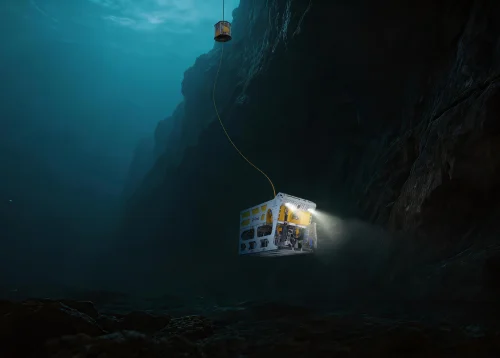
Deep-sea environments contain mineral resources that have attracted growing interest from marine engineering companies, research institutions, and offshore technology developers. Exploring and collecting these resources requires equipment capable of operating under high hydrostatic pressure, low temperatures, limited visibility, and complex seabed conditions.
A deep-sea mining robot is designed to perform remote operations in such environments. Depending on its configuration, it may support seabed exploration, mineral sampling, excavation, material collection, and other specialized subsea tasks.
Compared with conventional underwater vehicles used mainly for observation, mining robots require additional capabilities for physical interaction with the seabed and handling of collected materials.
Developing these systems involves the integration of mechanical engineering, subsea hydraulics, robotic control, positioning technology, and deepwater structural design.
What Is a Deep-Sea Mining Robot?
A deep-sea mining robot is an underwater robotic platform designed to perform mineral exploration or resource collection tasks on the seabed.
It may operate as a tracked vehicle, a remotely operated excavation system, or a specialized seabed machine connected to a surface support vessel.
A typical system may include:
- Pressure-resistant structural components
- Underwater propulsion or crawler tracks
- Excavation and collection equipment
- Hydraulic power systems
- Subsea cameras and sonar
- Navigation and positioning sensors
- Umbilical and control systems
- Material transport or collection equipment
The exact configuration depends on the target material, operating depth, seabed geology, and intended operation.
Some robots are designed primarily for exploration and sampling, while others focus on excavation and material collection.
Main Applications of Deep-Sea Mining Robots
Deep-sea mining robots can support several stages of subsea resource operations.
1. Seabed Mineral Exploration
Before any collection operation begins, engineers need information about the seabed and the distribution of target materials.
ROVs and specialized underwater robots can carry cameras, sonar, sampling tools, and other instruments to examine selected areas.
They can collect visual and environmental data to support geological surveys and resource assessment.
2. Mineral Sampling
Sampling provides information about the composition and characteristics of seabed materials.
A robotic system can be equipped with a sampling tool or manipulator to collect material from selected locations.
The collected samples can then be analyzed to understand mineral content, sediment characteristics, and geological conditions.
3. Seabed Excavation
Some deep-sea mining systems use mechanical cutting tools or other excavation mechanisms to loosen material from the seabed.
The excavation system must be designed according to the hardness, particle size, and distribution of the target material.
Vehicle traction and stability are particularly important because excavation generates reaction forces that can affect the robot’s position.
4. Material Collection and Handling
After excavation, collected material must be gathered and transferred to a suitable collection or transportation system.
This process may involve suction systems, mechanical collectors, hoppers, or other specialized equipment.
The design depends on material characteristics and the intended transport method.
Key Technologies Behind Deep-Sea Mining Robots
Deep-sea mining equipment must address several technical challenges that are less significant in shallow-water operations.
Pressure-Resistant Structural Design
Water pressure increases with depth. Structural housings, electrical enclosures, connectors, and other pressure-sensitive components must be designed for the intended operating depth.
Material selection, sealing arrangements, pressure compensation, and structural testing are important parts of system development.
A machine’s depth rating should be considered together with the ratings of its sensors, actuators, cameras, and hydraulic components.
Subsea Hydraulic Systems
Hydraulic systems are widely used in underwater engineering because they can provide substantial force for mechanical operations.
In a deep-sea mining robot, hydraulics may power cutting heads, manipulators, excavation tools, and other working mechanisms.
The system must maintain stable performance under the expected pressure and temperature conditions.
Seabed Mobility
Deep-sea terrain can include soft sediment, uneven surfaces, slopes, and areas with varying soil resistance.
Tracked mobility systems can help a robot move across the seabed while maintaining contact with the working surface.
Track geometry, ground pressure, traction, and vehicle weight distribution all influence mobility.
Remote Control and Monitoring
Deep-sea mining robots are generally operated remotely from a surface control station.
Operators need information about vehicle position, tool status, operating parameters, and surrounding conditions.
Cameras and sonar support navigation and observation, while additional sensors can provide feedback about the excavation process.
Reliable communication between the vehicle and surface system is essential for coordinated operation.
Excavation and Collection Technology
The excavation mechanism must match the target material.
Mechanical cutting may be appropriate for certain hard or compacted materials, while suction-based collection may be more suitable for loose deposits.
In some applications, multiple systems may be integrated to support different stages of the operation.
Engineering Challenges in Deep-Sea Mining Operations
Designing a deep-sea mining robot involves more than increasing the depth rating of an existing ROV.
Several engineering issues must be addressed together.
High-pressure operation: Structural components and electrical systems must remain reliable under sustained hydrostatic pressure.
Limited visibility: Suspended sediment generated during excavation can reduce camera visibility. Sonar and other sensors can help maintain situational awareness.
Seabed disturbance: Excavation and material collection may disturb surrounding sediments. Environmental assessment and monitoring are necessary when evaluating potential impacts.
Vehicle stability: Cutting and collection operations create forces that can affect the robot’s position. The vehicle must maintain adequate traction and stability.
Power management: Excavation tools and propulsion systems may require substantial power. The surface power supply, umbilical, and onboard distribution system must be designed accordingly.
Material transportation: Moving collected material from the seabed to the surface involves complex engineering and logistical requirements.
These challenges make system integration a central part of deep-sea mining equipment development.
Environmental Considerations
Deep-sea environments can contain sensitive ecosystems and habitats that are not fully understood.
Mining-related activities may generate sediment plumes, disturb seabed habitats, and affect organisms living on or within the seabed.
Responsible project development therefore requires environmental baseline studies, impact assessment, monitoring, and compliance with applicable regulations.
Robotic systems can support environmental research by collecting seabed images, samples, and operational data. However, the use of advanced equipment does not eliminate the need for careful environmental management.
How to Select a Deep-Sea Mining Robot
Equipment selection should begin with a clear definition of the operation.
Key considerations include:
- Required operating depth
- Target mineral or seabed material
- Seabed hardness and geological conditions
- Excavation method and working dimensions
- Required material collection capacity
- Vehicle traction and stability
- Power and hydraulic requirements
- Positioning, navigation, and monitoring systems
- Surface vessel and launch-and-recovery arrangements
The robot should be evaluated as part of the complete subsea operation rather than as an isolated machine.
VVLAI Deep-Sea Robotic Engineering
VVLAI develops underwater robotic equipment for deep-sea engineering, subsea excavation, and specialized marine operations.
Its development experience includes deep-sea operation robots and subsea equipment designed for demanding underwater environments. The company has also developed specialized mining-related robotic systems, including a commercial suction-filter mining robot for amber mining.
For deep-sea resource projects, equipment configuration must be matched to the target material, operating depth, excavation requirements, and environmental conditions.
As underwater resource exploration technologies continue to develop, deep-sea mining robots will remain an important part of the broader subsea engineering ecosystem.
