
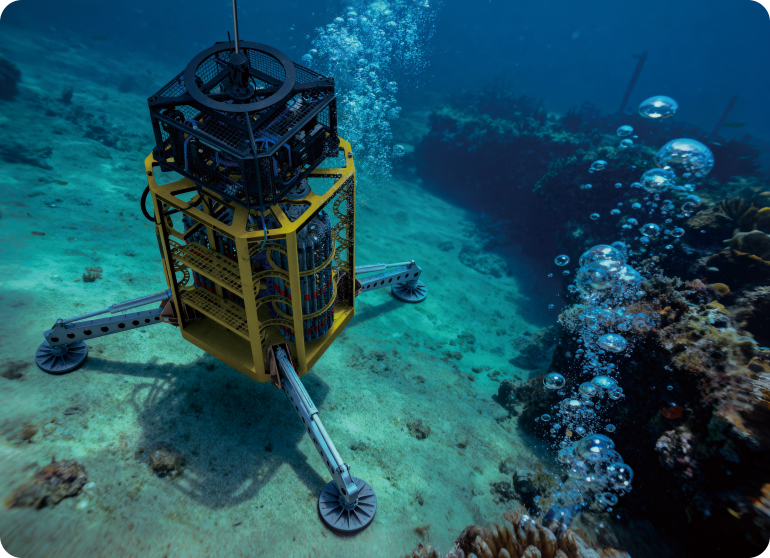
Underwater search and rescue operations are often conducted under difficult conditions. Sunken vessels, submerged vehicles, missing objects, and underwater structural failures may require search teams to work in environments with limited visibility, strong currents, unstable terrain, or significant water depth.
Traditional search operations may involve divers, sonar equipment, surface vessels, and other specialized resources. However, direct underwater access can be dangerous or impractical, particularly when the search area is deep, confined, or structurally unstable.
An underwater search and rescue robot provides a remote platform for locating targets, collecting visual information, and supporting certain recovery operations.
By integrating cameras, sonar, positioning systems, and optional manipulators, an ROV can help search teams obtain information from underwater environments before deciding how to proceed.
What Is an Underwater Search and Rescue Robot?
An underwater search and rescue robot is a remotely operated underwater vehicle designed to support search, inspection, and recovery-related tasks.
Most systems are based on ROV technology. They are connected to a surface control station through an umbilical cable, allowing operators to control movement and monitor underwater images in real time.
Depending on the mission, the robot may be equipped with:
- High-definition underwater cameras
- LED lighting
- Imaging sonar
- Navigation and positioning sensors
- Depth and altitude sensors
- Robotic manipulators
- Gripping or retrieval tools
- Communication and recording systems
The equipment configuration should be selected according to the search target, water depth, visibility, and recovery requirements.
Main Applications in Underwater Search and Rescue
Underwater search and rescue robots can support a range of operations.
1. Sunken Vessel Search
When a vessel sinks, search teams may need to locate the wreck, examine its position, and assess the surrounding underwater environment.
An ROV can be deployed to search designated areas using cameras and sonar.
Once the wreck is located, the robot can inspect its external structure and collect visual information about damage, orientation, and surrounding debris.
This information can help engineers and rescue teams plan subsequent operations.
2. Submerged Vehicle Search
Accidents involving vehicles entering rivers, reservoirs, or coastal waters can require underwater search operations.
An ROV can help examine the seabed, locate visible vehicle components, and provide images of the target area.
Sonar is particularly useful when visibility is poor or the search area contains suspended sediment.
3. Underwater Object Recovery
Some search missions involve locating and recovering equipment, cargo, or other objects.
A vehicle equipped with a manipulator or gripping tool may assist with handling objects that fall within its rated payload and operating capability.
For larger objects, the ROV may help position lifting equipment or prepare the recovery operation rather than carrying out the entire recovery itself.
4. Damaged Underwater Infrastructure
Search and rescue equipment can also support inspections following underwater infrastructure failures.
For example, a robot may examine damaged pipelines, submerged structures, or debris fields to help identify the location and condition of affected components.
The collected information can support decisions about access, repair, and recovery.
5. River and Reservoir Search Operations
Inland water environments present specific challenges, including low visibility, soft sediment, underwater vegetation, and limited access.
Compact ROVs can be deployed from suitable support platforms to inspect selected areas and locate submerged objects.
Vehicle size, propulsion, tether management, and sonar capability are particularly important in these environments.
How ROVs Support Underwater Search Operations
An underwater search mission usually involves several stages.
Step 1: Defining the Search Area
Before deployment, the search team establishes the target area using available information such as last known position, surface observations, sonar data, or other survey results.
A search plan helps organize vehicle movement and reduce unnecessary coverage.
Step 2: Deploying the ROV
The vehicle is launched from a suitable vessel or platform.
Operators check the vehicle’s communication, propulsion, camera, lighting, and sensor systems before beginning the search.
Step 3: Searching with Cameras and Sonar
The ROV follows the planned search route while collecting underwater images and acoustic information.
Cameras provide detailed views when visibility is sufficient. Sonar can help detect objects and structures when optical visibility is limited.
Combining the two technologies improves the operator’s ability to identify potential targets.
Step 4: Target Identification and Inspection
When a potential target is detected, the vehicle moves closer for a more detailed examination.
Operators may change the camera angle, adjust lighting, or use sonar to understand the target’s shape and position.
The collected information can help determine whether the object matches the search target.
Step 5: Recovery Support
If the mission requires object recovery, the ROV may use a manipulator or specialized tool to handle suitable objects.
For heavy or unstable objects, additional lifting systems and surface support equipment are generally required.
The recovery plan should consider object weight, attachment points, underwater conditions, and potential structural damage.
The Importance of Sonar in Low-Visibility Conditions
Visibility is one of the biggest challenges in underwater search operations.
In rivers, reservoirs, ports, and other environments with high sediment levels, cameras may provide only a limited view of the surrounding area.
Imaging sonar uses acoustic signals to detect underwater objects and structures. It can help operators identify potential targets and maintain awareness when visual information is insufficient.
Different sonar systems provide different levels of detail and coverage. Selection depends on the search area, target size, water conditions, and required detection range.
Sonar does not replace visual inspection entirely. Once a target is located, cameras remain useful for closer examination and documentation.
Choosing the Right Underwater Search and Rescue Robot
Not all ROVs are suitable for every search mission. Several technical factors should be evaluated before deployment.
Operating Depth
The ROV must be designed for the expected water depth. The ratings of cameras, connectors, sensors, and other onboard equipment should also be checked.
Propulsion and Maneuverability
The vehicle should maintain stable movement in the expected current conditions.
For confined environments, compact dimensions and precise control may be particularly important.
Imaging and Lighting
Camera resolution, lighting power, and viewing angle influence target identification.
A suitable configuration should account for the expected visibility and distance between the vehicle and the target.
Sonar Compatibility
For low-visibility operations, sonar can provide valuable information that cameras cannot capture reliably.
The vehicle should support the required sonar system and provide an appropriate operator interface.
Manipulator and Recovery Tools
If the mission includes object handling, the vehicle may require a manipulator or specialized retrieval equipment.
The tool’s reach, gripping force, payload capacity, and control method should match the target object.
Tether Management
The umbilical cable connects the ROV to the surface control station. Its length, handling arrangement, and resistance to environmental conditions can affect the operating range and mission efficiency.
For complex search areas, tether management should be included in the deployment plan.
Safety and Operational Planning
An underwater search and rescue robot can reduce the need for direct human access to hazardous underwater areas, but the operation still requires careful planning.
Before deployment, teams should evaluate water depth, currents, underwater obstacles, vessel position, tether routes, and potential entanglement hazards.
Communication procedures should also be established between the ROV operator, surface vessel crew, and other rescue personnel.
For missions involving human remains or potential survivors, the use of ROVs must be coordinated with the relevant emergency response authorities and established rescue procedures. Robotic equipment is a support tool, not a substitute for professional rescue teams.
VVLAI Underwater Robotic Systems
VVLAI develops ROVs and specialized underwater robotic equipment for inspection, marine engineering, and subsea operations.
Its product range includes compact inspection ROVs and larger work-class systems that can be configured for different operating requirements. Depending on the mission, equipment may integrate underwater cameras, sonar, manipulators, and other specialized tools.
For underwater search and recovery applications, the right configuration depends on water depth, search area, target characteristics, visibility, and required intervention capability.
Conclusion
Underwater search and rescue operations require reliable equipment that can provide access to challenging underwater environments and deliver useful information to surface teams.
An underwater search and rescue robot can support target detection, visual inspection, sonar-assisted searching, and selected object-handling tasks. By reducing dependence on direct underwater access, ROV technology provides an important tool for modern marine search operations.
Successful deployment still depends on appropriate equipment selection, trained operators, careful mission planning, and coordination with professional rescue teams.
