
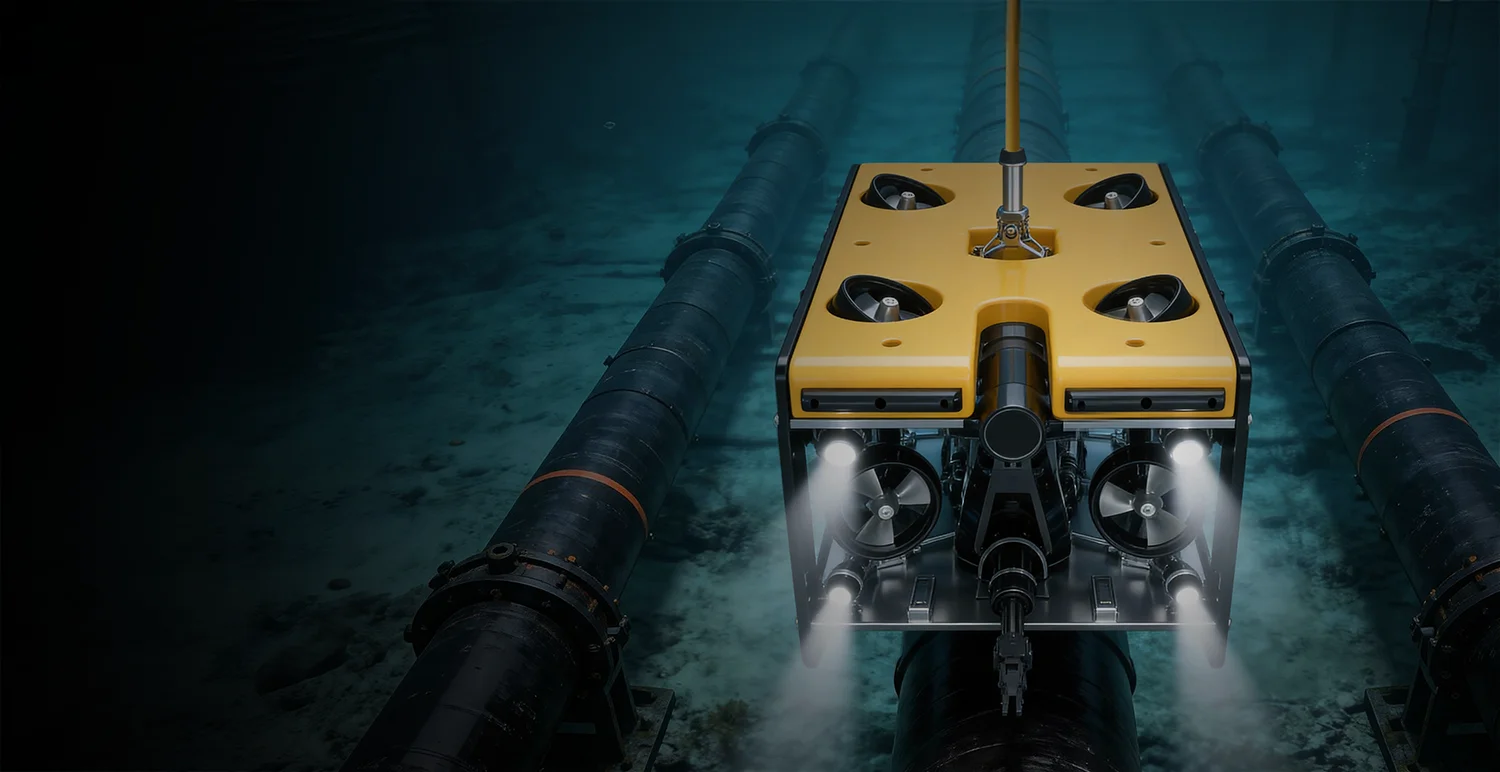
The global offshore wind industry is entering a new phase of growth. As wind farms move farther offshore and into deeper waters, developers face increasing challenges related to inspection, maintenance, cable protection, and long-term asset management.
While offshore wind turbines are designed for service lives of 25 years or more, maintaining these assets beneath the waterline remains one of the industry’s most complex and expensive tasks. Foundations, export cables, array cables, scour protection systems, and subsea structures all require regular inspection and maintenance to ensure safe and efficient operation.
This is where ROVs (Remotely Operated Vehicles) have become indispensable.
Today, ROVs are no longer viewed simply as underwater cameras. They have evolved into critical subsea engineering tools capable of performing inspection, intervention, cable monitoring, and maintenance support tasks across the entire offshore wind lifecycle. Industry studies increasingly show that robotic systems are helping operators improve safety, reduce offshore exposure, and increase inspection efficiency.
The Growing Challenge of Offshore Wind Operations
The scale of modern offshore wind projects has changed dramatically over the last decade.
New offshore wind farms are being developed further from shore, often in harsher marine environments and deeper waters than earlier projects. These conditions make routine inspections more difficult and increase dependence on specialized vessels, divers, and weather windows.
For operators, several underwater assets require continuous monitoring:
- Turbine foundations
- Monopiles and jackets
- Subsea export cables
- Inter-array cables
- Scour protection systems
- Cable crossings
- Subsea connectors and structures
Any failure in these systems can lead to costly downtime and expensive repair campaigns.
As offshore wind capacity continues to expand worldwide, operators are seeking more efficient ways to monitor and maintain underwater infrastructure.
Why ROVs Are Replacing Traditional Inspection Methods
Historically, many underwater inspections relied on commercial divers.
Although diving remains necessary in certain situations, it presents significant limitations:
- Restricted operating depth
- Safety risks
- Weather dependency
- Limited working duration
- High mobilization costs
ROVs overcome many of these challenges.
Unlike divers, ROVs can operate for extended periods, work at greater depths, and perform inspections in environments that may be hazardous for human personnel. Modern systems equipped with HD cameras, imaging sonar, laser scanners, and positioning sensors can collect highly detailed data without requiring personnel to enter the water.
This shift is one of the primary reasons why offshore wind operators increasingly integrate ROV technology into their inspection and maintenance programs.
Key Applications of ROVs in Offshore Wind Farms
Subsea Cable Inspection
Subsea cables represent one of the most critical assets in any offshore wind project.
Array cables connect turbines within the wind farm, while export cables transmit power back to shore. Damage caused by seabed movement, fishing activities, anchors, or insufficient burial depth can lead to significant operational disruptions.
ROVs are widely used to:
- Verify cable burial depth
- Inspect cable crossings
- Detect exposure and free spans
- Monitor cable protection systems
- Support post-lay inspections
Accurate cable inspection helps operators identify risks before they become major failures.
Foundation and Structural Inspection
Offshore wind foundations are constantly exposed to waves, currents, and corrosion.
ROVs can perform close visual inspections of:
- Monopiles
- Jacket structures
- Welds
- Bolted connections
- Corrosion protection systems
By collecting high-quality visual and sonar data, operators can assess structural integrity without requiring expensive shutdowns or diver intervention.
Scour Monitoring
Seabed erosion around turbine foundations remains a significant concern for offshore wind developers.
ROVs equipped with sonar and mapping systems can monitor seabed conditions and detect changes in scour protection systems over time.
Regular monitoring allows operators to plan corrective actions before structural stability becomes compromised.
Construction Support
ROVs are also heavily involved during the installation phase of offshore wind projects.
Typical tasks include:
- Pre-installation surveys
- Foundation positioning support
- Cable routing verification
- Trenching supervision
- Post-installation inspections
During cable installation campaigns, ROVs often work alongside trenching systems and cable burial equipment to ensure accurate placement and protection.
The Rise of Work Class ROVs
As offshore wind projects become larger and more complex, demand for Work Class ROVs continues to grow.
Unlike observation-class vehicles, Work Class ROVs are designed for intervention tasks requiring higher power and payload capacity.
Typical capabilities include:
- Robotic arm operations
- Tool deployment
- Torque tool integration
- Valve manipulation
- Cable intervention
- Debris removal
These systems enable operators to complete certain underwater tasks without deploying divers, significantly improving operational flexibility.
For offshore wind operators managing large asset portfolios, Work Class ROVs provide a practical solution for both planned maintenance and emergency response operations.
Safety Benefits of Subsea Robotics
One of the strongest drivers behind ROV adoption is safety.
Offshore operations involve numerous risks, including:
- Rough sea states
- Strong currents
- Limited visibility
- Deep-water environments
Every task performed by an ROV instead of a diver reduces personnel exposure to hazardous conditions.
Recent industry projects have demonstrated how robotic inspection systems can successfully perform inspections both above and below the waterline while minimizing human access to dangerous offshore environments.
As health and safety standards become increasingly important across the offshore energy sector, robotic solutions are expected to play an even larger role.
Future Trends: Autonomous and Resident Systems
The next evolution of offshore wind inspection is already underway.
Industry research points toward greater integration of:
- Resident subsea robots
- Autonomous underwater vehicles (AUVs)
- AI-assisted inspections
- Digital twins
- Predictive maintenance systems
Instead of mobilizing vessels for every inspection campaign, future offshore wind farms may rely on resident robotic systems stationed offshore for continuous monitoring and rapid response.
These technologies could significantly reduce maintenance costs while providing operators with real-time visibility into asset health.
Conclusion
ROVs have become a core technology for modern offshore wind operations.
From cable inspections and foundation surveys to intervention and maintenance support, these underwater robotic systems help operators improve safety, increase efficiency, and reduce reliance on costly offshore campaigns.
As offshore wind projects continue moving into deeper waters and more challenging environments, the importance of reliable subsea robotics will only increase. Operators that invest in advanced ROV solutions today will be better positioned to manage risk, optimize maintenance strategies, and maximize the long-term performance of their offshore assets.
For offshore wind developers, EPC contractors, and asset owners, ROV technology is no longer an optional tool—it is becoming a fundamental component of successful offshore wind operations.
