
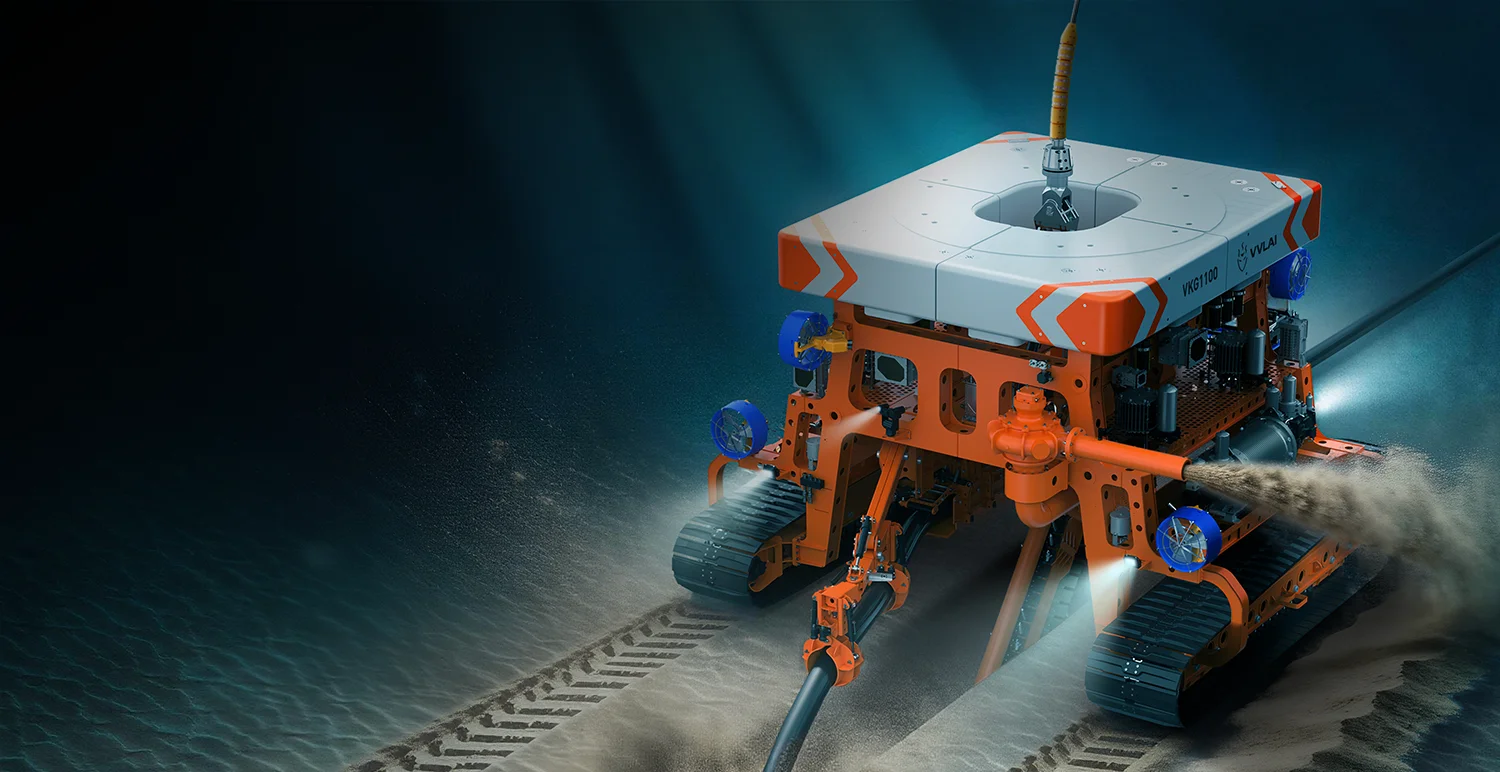
Offshore wind farms depend on an extensive network of subsea cables to transmit electricity from individual turbines to offshore substations and ultimately to shore. These cables operate in an environment where seabed movement, fishing activities, anchors, and changing marine conditions can create long-term risks.
For this reason, subsea trenchers for offshore wind farms play an important role in cable installation and protection. By creating trenches in the seabed, these machines help place cables below the seabed surface and reduce their exposure to external hazards.
The effectiveness of a trenching operation depends on the equipment selected, the seabed geology, the cable design, and the installation strategy.
Understanding Cable Networks in Offshore Wind Farms
Most offshore wind farms contain two main categories of electrical cables.
Inter-array cables connect individual wind turbines to one another and carry electricity toward an offshore substation. Export cables then transmit the collected electricity toward the onshore grid connection.
Both cable types require appropriate protection, although their installation conditions and project specifications may differ.
Inter-array cables follow routes between turbines, where seabed conditions can vary across relatively short distances. Export cables may extend over much longer distances and cross multiple geological zones.
These differences influence trenching depth, equipment selection, cable handling, and installation scheduling.
A successful cable protection strategy begins during route engineering rather than after the installation vessel reaches the site.
What Is a Subsea Trencher?
A subsea trencher is a specialized underwater machine designed to excavate the seabed for pipelines or submarine cables.
Depending on the design, it may use mechanical cutting tools, hydraulic jetting systems, or a combination of excavation technologies. Many systems are remotely operated and use cameras, sonar, positioning equipment, and onboard sensors to support underwater operations.
Subsea trenchers are commonly categorized by their excavation method and mobility system.
Mechanical Trenchers
Mechanical trenchers use cutting chains or other tools to break up seabed material. They are suited to applications where the soil requires mechanical excavation rather than water jetting alone.
Their performance depends on cutting power, tool design, ground pressure, and traction.
Jetting Trenchers
Jetting trenchers use pressurized water to loosen sediment. They can be effective in suitable sandy or unconsolidated soils and may offer high excavation rates under favorable conditions.
However, jetting performance can decrease in compacted or cohesive soils, making site-specific assessment essential.
Hybrid Trenching Systems
Some equipment combines different excavation methods to improve adaptability. A hybrid configuration can be useful where soil conditions vary or where a project requires both cutting and hydraulic excavation.
The appropriate system should be selected according to the ground investigation data and required trench specifications.
How Subsea Trenchers Protect Cables
The primary purpose of cable trenching is to create a protective layer of seabed material above an installed cable.
When a cable is buried at the required depth, it is less directly exposed to anchors, fishing gear, and other external hazards. Burial can also help stabilize the cable’s position, depending on local seabed conditions.
A typical post-lay burial operation involves several stages.
First, the cable route and seabed conditions are assessed. Engineers use survey data to identify route constraints, changes in ground composition, and areas where additional protection may be needed.
Second, the cable is installed along the planned route. Installation may involve a dedicated cable-laying vessel and specialized cable handling equipment.
Third, a subsea trencher follows the route and excavates the seabed around or beneath the cable, depending on the machine’s design.
Finally, the completed section is inspected to assess burial quality and identify any areas requiring corrective work.
Some systems can trench and lay cable in one integrated operation, reducing the need for separate passes.
Why Seabed Conditions Matter
No single trenching technology performs equally well in every geological environment.
Sandy seabeds may allow efficient hydraulic jetting. Soft sediments can be relatively easy to excavate, but excessive water flow may cause unnecessary sediment disturbance.
Clay presents a different challenge. Its cohesive structure can resist jetting, particularly when the material is dense or consolidated. Mechanical cutting or a more powerful excavation configuration may be required.
Hard ground and weathered rock can demand specialized tooling and careful control of machine movement.
The seabed may also contain slopes, depressions, existing cables, and other obstacles. These features affect traction and the machine’s ability to maintain a consistent trench profile.
For offshore wind developers, a detailed seabed survey is therefore essential before choosing a trenching system.
Important Performance Parameters
Several technical parameters should be considered when evaluating a subsea trencher.
Operating depth determines the water-depth range in which the machine can work. It should be compatible with the deepest section of the planned route, with suitable operating margins.
Trenching depth indicates how deeply the equipment can excavate. The required value should be established by project specifications and risk assessments.
Trenching width affects the dimensions of the excavated channel and should be compatible with the cable configuration and burial requirements.
Propulsion and traction determine whether the machine can move reliably across the seabed. Track systems may be beneficial in certain soft-ground conditions, while other designs may suit different terrain.
Power and excavation capability influence the machine’s ability to handle the expected soil strength.
Sensor integration supports positioning, monitoring, and operational control.
These specifications should be evaluated together. A machine with high power output may still be unsuitable if its ground pressure, cutting tools, or maneuverability do not match the site conditions.
The Role of ROVs in Cable Trenching
ROVs complement subsea trenchers by providing underwater observation and intervention capabilities.
During installation, an ROV can help inspect cable routing, observe equipment behavior, and assess local seabed conditions. After burial, it may support verification of cable protection and identify exposed sections or areas where further work is required.
Work-class ROVs can also support more complex tasks through robotic arms and specialized tooling.
Integrating trenching equipment with appropriate inspection systems provides a clearer picture of the operation and helps engineers respond to unexpected conditions.
Improving Efficiency During Offshore Wind Installation
Offshore wind installation campaigns are expensive because they depend on specialized vessels, trained personnel, and suitable weather conditions.
Efficient trenching can help reduce the time required to complete cable protection work. However, maximizing speed should not come at the expense of burial quality.
A more effective strategy combines appropriate equipment selection with route planning, real-time monitoring, and realistic performance expectations.
For example, dividing a route into sections according to seabed types may help contractors identify where jetting is appropriate and where mechanical excavation is more suitable.
Preventive maintenance is also important. Inspection of pumps, cutting tools, propulsion systems, sensors, and hydraulic components can reduce the risk of unexpected equipment downtime during offshore operations.
How to Select the Right Subsea Trencher
When evaluating equipment, project teams should begin with the cable route and engineering requirements.
Key questions include:
- What are the expected soil types and strength ranges?
- What burial depth and trench width are required?
- What are the maximum water depth and operating conditions?
- Will trenching occur before, during, or after cable laying?
- Are there route sections that require specialized tooling?
- What inspection and positioning systems are needed?
The answers help determine whether a mechanical trencher, jetting system, hybrid machine, or towed plow is the most appropriate choice.
VVLAI provides subsea trenchers and related underwater engineering equipment for cable burial, pipeline protection, and offshore infrastructure projects. Different equipment configurations address different seabed and operational requirements, allowing project teams to evaluate solutions according to their technical needs.
Conclusion
Subsea trenchers are an important part of offshore wind cable protection. Their effectiveness depends on the relationship between excavation technology, seabed geology, cable specifications, and operational planning.
By selecting suitable equipment and verifying burial quality throughout installation, contractors can improve cable protection and reduce long-term maintenance risks.
As offshore wind capacity grows, dependable subsea trenching systems will continue to support the reliability of the underwater infrastructure that connects renewable energy projects to the power grid.
