
Underwater dredging is required in a wide range of projects, from reservoir maintenance and port operations to underwater construction and sediment removal. The choice of equipment can significantly affect productivity, access, operating cost, and the amount of disruption caused during excavation.
Traditional dredging equipment remains effective for many large-scale projects. However, certain underwater tasks are difficult to complete using conventional surface-operated systems alone.
In these situations, underwater dredging robots can provide an alternative by moving closer to the excavation area and performing controlled operations under remote supervision.
Understanding the differences between robotic and conventional dredging helps project owners choose equipment that matches the site conditions and required outcome.
What Is Conventional Dredging Equipment?
Conventional dredging systems generally use surface vessels, excavators, cutter heads, buckets, or suction systems to remove sediment from the seabed or bottom of a waterway.
Their configuration depends on the project. Large dredgers can handle substantial material volumes and are widely used for navigation channels, port development, land reclamation, and major waterway projects.
Some systems use mechanical excavation, while others rely on hydraulic suction to transport sediment through pipelines.
Conventional equipment is often well suited to open areas where vessel access is available and the excavation footprint is large enough to justify mobilization.
However, confined spaces, obstacles, existing infrastructure, and difficult underwater access can complicate operations.
What Is an Underwater Dredging Robot?
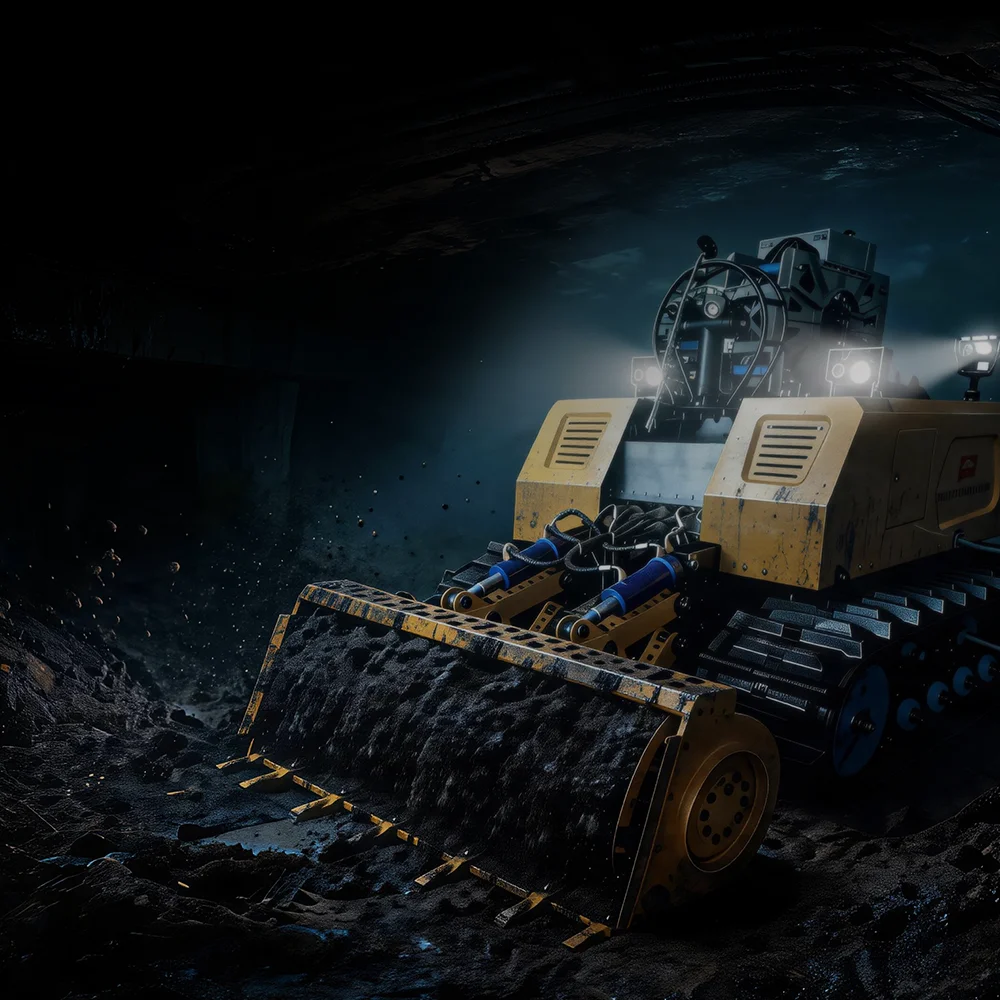
An underwater dredging robot is a remotely operated machine designed to remove sediment, sludge, or other material beneath the water surface.
Depending on the design, it may use crawler tracks, hydraulic power, auger heads, high-flow slurry pumps, or other excavation tools.
The operator controls the machine from a remote station and monitors its performance through cameras and sensors.
Some systems are compact enough for deployment in restricted areas. Others are built for demanding dredging tasks and use powerful hydraulic and pumping equipment.
Their capabilities vary considerably, so project teams should assess the specific operating depth, excavation method, pump performance, mobility, and material handling capability of each model.
Key Differences Between Robotic and Conventional Dredging
1. Access to Confined Areas
Conventional dredging vessels may require sufficient space for positioning, excavation, and sediment transport.
A crawler-based dredging robot can sometimes operate in areas where a large dredging vessel cannot work effectively. Examples may include sections beneath structures, restricted underwater spaces, or areas where precise local excavation is required.
This advantage depends on access arrangements, launch and recovery requirements, and the physical dimensions of the equipment.
2. Excavation Control
Robotic systems allow operators to control movement and excavation near the target area.
Cameras, sonar, and other sensors can help monitor the equipment’s position and surrounding conditions. Auger heads and other tools can be directed toward specific sediment deposits.
Conventional systems also provide accurate control when properly configured, particularly on large, well-defined projects. The difference is not that robots are always more precise, but that their mobility and remote operation may be advantageous for certain localized tasks.
3. Sediment Transport
Both robotic and conventional dredging systems may use suction pumps to transport excavated material.
Performance depends on pump flow rate, pressure, pipe diameter, sediment properties, and discharge distance.
Cohesive sludge, large particles, and debris can create blockages or reduce transport efficiency. The system must therefore be designed for the material expected at the site.
Some robotic systems combine an auger head with a high-flow slurry pump to loosen and remove compacted sediment. Others may use different cutting or suction arrangements.
4. Deployment and Mobilization
Large dredging vessels are well suited to substantial projects but may involve significant mobilization requirements.
A smaller underwater robot may be easier to transport and deploy for selected maintenance tasks. Nevertheless, it still requires appropriate lifting equipment, power, control systems, and material discharge arrangements.
The total deployment cost should be compared with the expected project output rather than assuming that a smaller machine will always be less expensive.
5. Operational Flexibility
Robotic dredgers may be adapted to different working tools or configurations, depending on their design.
This can be useful for projects involving several localized tasks or changing underwater conditions.
Conventional dredging equipment may provide higher production capacity for large continuous excavation areas. The appropriate choice depends on whether the project prioritizes localized access, excavation volume, flexibility, or sustained production.
Applications of Underwater Dredging Robots
Reservoir and Dam Maintenance
Reservoirs can accumulate sediment over time, reducing usable storage capacity or affecting water management.
Underwater dredging robots may help remove sediment from selected areas, especially where conventional equipment faces access constraints.
Before work begins, engineers should assess sediment composition, water depth, access arrangements, and requirements for handling or disposing of the removed material.
Port and Harbor Maintenance
Ports require suitable water depths for safe vessel movement.
Robotic dredging equipment can support localized sediment removal around structures, restricted areas, and underwater facilities. Larger dredging vessels may remain the preferred option for extensive channel maintenance.
The two approaches can be complementary rather than mutually exclusive.
Industrial and Chemical Facilities
Industrial facilities may require underwater sediment removal from basins, ponds, or other water-containing structures.
In these environments, the nature of the material is particularly important. Sediment may contain industrial residues or other contaminants, requiring specialized handling, environmental controls, and disposal procedures.
Equipment selection should account for the material’s properties and the applicable safety requirements.
Underwater Construction
Construction projects may require localized excavation around foundations, pipelines, or other subsea structures.
Robotic dredging equipment can support controlled sediment removal where access is limited or where the excavation needs to be concentrated in a particular area.
The operation must be coordinated with existing infrastructure and any structural restrictions.
Factors That Influence Dredging Performance
Several technical factors determine whether an underwater dredging robot can perform effectively.
Pump flow and pressure: These influence the ability to move slurry through the discharge system, but neither value should be evaluated in isolation.
Excavation tool design: Augers, cutter heads, and other tools must suit the sediment and debris expected at the site.
Mobility: Tracks and other movement systems should provide adequate traction without creating excessive ground pressure.
Operating depth: The complete machine and its components must be rated for the intended water depth.
Visibility and sensing: Cameras, lighting, sonar, and depth sensors help operators monitor progress and control the equipment.
Discharge arrangements: The distance to the discharge point, pipe configuration, and material characteristics can significantly affect system performance.
Project teams should evaluate these factors together rather than relying on a single specification.
Environmental and Safety Considerations
Dredging can disturb sediment and increase suspended solids in the water. Depending on the material and location, it may also affect nearby habitats or release contaminants.
A responsible dredging plan should include an assessment of sediment characteristics, potential environmental impacts, and appropriate monitoring measures.
Remote operation can reduce the need for personnel to work directly in hazardous underwater conditions, but it does not remove the need for safe lifting, electrical, hydraulic, and vessel procedures.
Operators must also consider the risks associated with cables, pipelines, structures, and unexpected debris in the excavation area.
How to Select the Right Equipment
The best equipment choice begins with a site assessment.
Project teams should establish the required excavation volume, sediment characteristics, water depth, access restrictions, discharge requirements, and acceptable operating timeframe.
For large, open excavation areas, a conventional dredger may offer the best production capacity. For localized work in restricted or complex underwater environments, a robotic system may provide greater operational flexibility.
In some projects, a combined approach can deliver the most practical result.
VVLAI provides underwater dredging robots and related subsea equipment for sediment removal, underwater construction, and marine engineering applications. Equipment selection should be based on actual site conditions and the required operational performance.
Conclusion
Underwater dredging robots and conventional dredging equipment serve different operational needs.
Conventional systems remain effective for large-scale excavation, while robotic systems can provide flexible access and controlled sediment removal in selected underwater environments.
The most suitable solution depends on sediment properties, excavation scale, operating depth, access, material transport, and project cost.
By evaluating these factors early, contractors can select equipment that supports efficient excavation while managing operational and environmental risks.
