
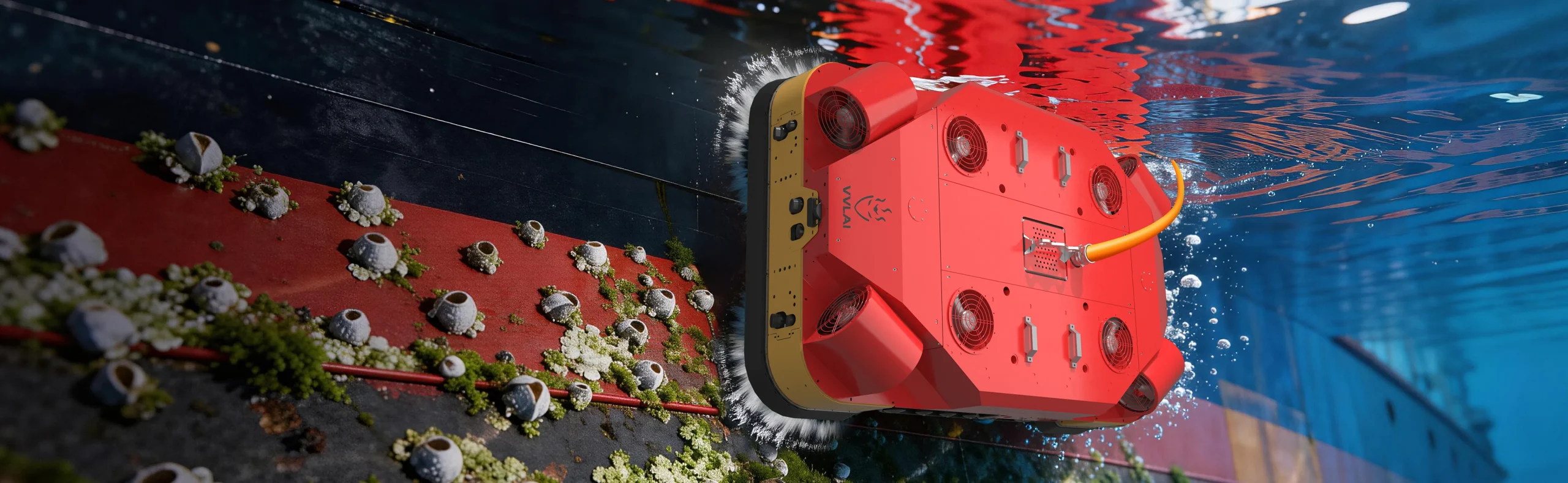
Marine biofouling is a persistent maintenance challenge for commercial vessels. Over time, algae, microorganisms, and larger marine organisms can accumulate on a ship’s hull, increasing surface roughness and affecting hydrodynamic performance.
Regular hull maintenance helps vessel operators manage fouling, maintain performance, and protect underwater coatings. Traditionally, cleaning has involved dry-docking or underwater work performed by divers. Robotic cleaning systems offer another option for suitable vessels and operating conditions.
Ship hull cleaning robots use remote control, propulsion, adhesion systems, and specialized cleaning tools to remove marine growth from underwater surfaces.
Their effectiveness depends on the hull condition, type of fouling, cleaning technology, vessel geometry, and environmental requirements.
Why Hull Cleaning Matters
A ship’s hull is designed to move through water with as little resistance as practical.
When marine organisms accumulate on the surface, they can increase drag. Depending on the vessel, the severity of fouling, and operating conditions, this may increase the energy required to maintain a given speed.
Fouling can also complicate inspections and maintenance by obscuring hull surfaces and protective coatings.
For operators, regular hull condition management is therefore connected to fuel efficiency, maintenance planning, and the vessel’s overall operating profile.
However, cleaning frequency should not be determined by a fixed schedule alone. Vessel type, trading route, water temperature, operating speed, coating system, and fouling history all influence how quickly marine growth develops.
What Is a Ship Hull Cleaning Robot?
A ship hull cleaning robot is an underwater vehicle designed to move along the vessel’s hull and remove fouling using an integrated cleaning mechanism.
Most systems include several major components:
- A propulsion or mobility system
- An adhesion mechanism
- Cleaning tools or brush assemblies
- Cameras and underwater lighting
- Remote control equipment
- Power and communication connections
Some robots use crawler tracks to move across the hull, while others rely on thrusters and magnetic adhesion. The correct arrangement depends on the vessel surface, cleaning method, and required mobility.
The operator controls the robot from a remote station and uses video feedback to monitor its position and progress.
Common Hull Cleaning Technologies
1. Brush-Based Cleaning
Brush systems use rotating brushes or brush discs to remove marine growth from the hull.
Their performance depends on brush material, rotational speed, contact pressure, and the type of fouling.
Brush cleaning can be suitable for certain fouling conditions, but the cleaning mechanism must be compatible with the hull coating. Excessive pressure or unsuitable brushes may damage protective surfaces.
Operators should therefore consider coating manufacturer guidance and the robot’s approved operating configuration.
2. Cavitation-Assisted Cleaning
Cavitation-assisted cleaning uses a controlled water-based process to generate cavitation effects near the cleaning surface.
Under appropriate operating conditions, this can help remove marine growth while reducing the need for direct abrasive contact.
The actual cleaning effect depends on system design, operating parameters, fouling type, and distance from the hull. Claims about coating safety should be supported by testing for the specific equipment and coating combination.
Cavitation-based systems may be attractive for applications where cleaning efficiency and control of surface contact are important.
3. Water-Jet Cleaning
Water-jet systems direct water through nozzles to remove fouling.
Their effectiveness depends on water pressure, flow, nozzle design, operating distance, and the type of marine growth.
Some systems are designed for localized cleaning, while others use multiple jets to cover larger areas.
As with other cleaning technologies, the system must be configured to avoid damaging coatings or creating unacceptable environmental effects.
Why Adhesion and Mobility Matter
A cleaning robot must remain stable against the hull while moving across curved and irregular surfaces.
Magnetic adhesion can be useful on compatible ferromagnetic hull structures. However, it is not universally suitable for all hull materials or coatings.
Thrusters can generate force to hold the vehicle against the surface and support steering. Track systems may help maintain controlled movement and provide a stable platform for cleaning tools.
Some systems combine magnets and thrusters to balance adhesion and maneuverability.
The design must account for hull curvature, appendages, sea chests, welds, openings, and other features that may interrupt the cleaning path.
The Role of Cameras and Sensors
Underwater visibility is often limited by lighting, suspended particles, and the debris generated during cleaning.
Cameras and LED lights allow operators to observe the hull and monitor cleaning progress. Multiple camera angles can help improve situational awareness around the vehicle.
Sensors can provide additional information about vehicle position, depth, movement, and operating status.
For larger cleaning campaigns, inspection data can help operators identify missed areas and document the condition of the hull before and after cleaning.
However, visual feedback should be interpreted carefully. A surface that appears clean on camera may still require closer inspection to assess coating condition or remaining marine growth.
Advantages of Robotic Hull Cleaning
Reduced Dependence on Diver Operations
Robotic cleaning can reduce the need for divers to perform routine hull-cleaning tasks, depending on the vessel and project requirements.
This may improve operational flexibility and reduce personnel exposure to underwater hazards.
Robots do not eliminate the need for trained operators, safe vessel procedures, or specialist underwater work where it remains necessary.
More Consistent Cleaning Coverage
Remote operation and camera feedback can help operators follow a planned cleaning path.
Track-based movement, controlled propulsion, and suitable cleaning tools can support repeatable coverage when properly configured.
Consistency still depends on operator training, hull geometry, fouling conditions, and the robot’s capabilities.
Potentially Shorter Maintenance Downtime
Cleaning can sometimes be carried out without sending the vessel to dry dock, provided the cleaning method is suitable and the work is permitted.
This may offer scheduling advantages for certain vessels.
However, robotic cleaning does not replace dry-docking when the vessel requires structural repairs, coating renewal, or other maintenance that cannot be completed underwater.
Improved Inspection Opportunities
Some robotic systems can combine cleaning with visual observation.
This can help operators identify areas of concern, including visible coating damage, marine growth accumulation, or other abnormalities that require further inspection.
Cleaning and inspection should be planned together when the project calls for both activities.
Environmental Considerations
Hull cleaning can release organisms, particles, and coating residues into the surrounding water.
For this reason, the environmental impact of a cleaning method must be considered before work begins.
The applicable requirements may depend on the vessel’s location, the type of fouling, the coating system, and whether the cleaning process captures or filters removed material.
Some ports and jurisdictions impose restrictions on in-water cleaning, particularly when it may release invasive species or harmful coating substances.
Operators should verify local requirements and select equipment with appropriate containment or waste-management arrangements where necessary.
The presence of a cleaning robot alone does not guarantee compliance with environmental regulations.
How to Choose a Hull Cleaning Robot
The right system depends on more than its advertised cleaning speed.
Key evaluation criteria include:
Cleaning technology: Determine whether brushes, cavitation, water jets, or another method is suitable for the vessel’s coating and expected fouling.
Cleaning efficiency: Assess the expected area coverage under realistic operating conditions rather than relying only on maximum theoretical rates.
Adhesion and mobility: Confirm that the system can remain stable and move across the intended hull surfaces.
Operating depth: Check the system’s rated depth and compatibility with the vessel’s underwater operating environment.
Imaging and control: Evaluate camera coverage, lighting, operator interface, and the ability to document cleaning progress.
Deployment and recovery: Consider lifting arrangements, deck space, power supply, cables, and the available maintenance infrastructure.
Environmental compliance: Confirm that the cleaning method and debris-handling arrangements meet applicable local requirements.
A site-specific assessment helps prevent problems caused by selecting equipment based on a single specification.
Maintenance of Robotic Cleaning Equipment
Hull cleaning robots also require routine maintenance.
Brushes, tracks, thrusters, seals, connectors, cameras, lights, and control systems should be inspected according to the manufacturer’s procedures.
Saltwater exposure makes corrosion control particularly important. Components should be cleaned, inspected, and stored appropriately after operation.
Operators should also verify the condition of power and communication cables, test emergency functions, and confirm that the cleaning mechanism operates correctly before deployment.
A well-maintained robot is more likely to deliver consistent performance throughout a cleaning campaign.
Conclusion
Ship hull cleaning robots provide a practical option for maintaining suitable vessel hulls without relying exclusively on divers or dry-docking.
Brush-based, cavitation-assisted, and water-jet systems offer different approaches to removing marine growth. Their effectiveness depends on the cleaning task, coating compatibility, adhesion, mobility, and environmental requirements.
For shipowners and marine service providers, equipment selection should begin with the vessel’s actual maintenance needs and the conditions under which cleaning will take place.
VVLAI develops underwater robotic equipment for hull cleaning and marine engineering applications. By evaluating the cleaning technology, vehicle stability, inspection capability, and operating requirements together, operators can select a solution that supports effective hull maintenance and responsible underwater operations.
