
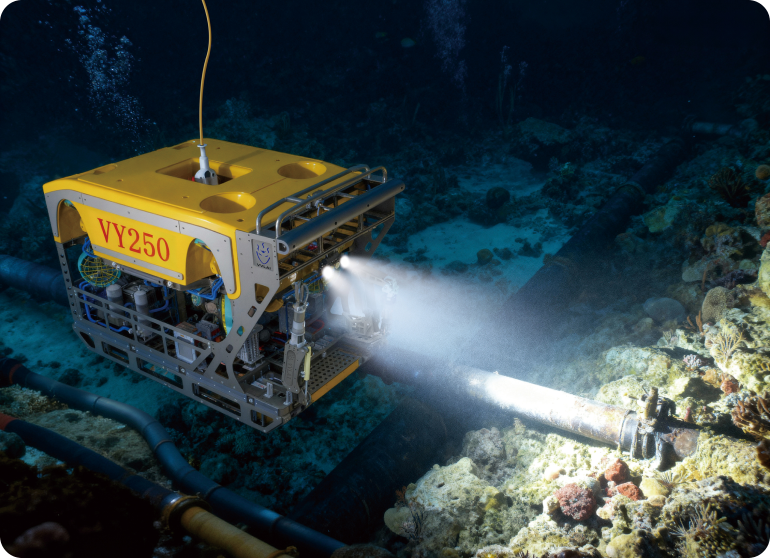
Subsea engineering projects often involve tasks that cannot be completed through visual inspection alone. Operators may need to turn valves, connect equipment, retrieve objects, cut cables, operate tools, or handle components on the seabed.
These operations require precise underwater interaction. An underwater robotic manipulator provides the mechanical capability to perform such tasks remotely, allowing an ROV to work with subsea equipment without requiring a diver to remain at the operation site.
As offshore oil and gas, renewable energy, marine research, and subsea construction projects become more complex, robotic manipulators are playing an increasingly important role in underwater intervention.
What Is an Underwater Robotic Manipulator?
An underwater robotic manipulator is a remotely operated mechanical arm designed to perform physical tasks underwater.
It is usually installed on an ROV or another subsea robotic platform. The operator controls the arm from a surface control station, using camera images and sensor feedback to guide its movements.
A typical manipulator system consists of:
- Robotic arm structure
- Multiple articulated joints
- Hydraulic or electric actuators
- Gripper or interchangeable end-effector
- Control system
- Position and status feedback components
The number of joints determines the manipulator’s movement flexibility. A multi-axis robotic arm can reach objects from different directions and perform more complex movements than a simple single-function tool.
Why Are Robotic Manipulators Important in Subsea Operations?
Underwater work presents several challenges that make manual intervention difficult.
Visibility may be limited, currents can affect vehicle stability, and operators must work around complex structures with restricted access. At greater depths, direct human intervention becomes increasingly demanding and costly.
A robotic manipulator helps address these challenges by providing remote physical interaction.
1. Valve and Equipment Operation
Offshore facilities use various subsea valves, connectors, and mechanical interfaces. Manipulators can be equipped with suitable tools to operate compatible components.
For example, an ROV may need to turn a valve handle, move a lever, or position a mechanical connector. The manipulator must have sufficient reach, joint flexibility, and force capability for the specific task.
2. Object Retrieval and Salvage
Marine salvage operations often require the recovery of objects from the seabed.
A manipulator equipped with an appropriate gripper can grasp, reposition, or retrieve smaller objects. Larger or heavier objects may require dedicated lifting systems, cutting tools, or specialized gripping devices.
The key is to select an end-effector that matches the object’s shape, size, material, and weight.
3. Subsea Construction and Installation
Underwater construction involves positioning components, handling tools, and assisting with equipment installation.
A robotic arm can help operators move small components into place, hold objects during an operation, or manipulate equipment in areas that are difficult for a work vessel to access directly.
4. Cable and Pipeline Intervention
Subsea cable and pipeline projects may require physical intervention during installation, maintenance, or repair.
Depending on the task, manipulators can support cable handling, tool positioning, and the operation of specialized cutting or connection equipment.
These applications require careful consideration of cable tension, bending radius, and the forces applied by the manipulator.
Understanding the Main Technical Specifications
Selecting an underwater robotic manipulator requires more than comparing the number of axes. Several technical parameters directly affect its operational capability.
Degrees of Freedom
Degrees of freedom describe how many independent movements the manipulator can perform.
A multi-axis manipulator provides greater flexibility when approaching objects from different angles. Five-axis and seven-axis systems can be configured for more complex underwater intervention tasks.
However, additional axes also increase control complexity. The manipulator should be selected according to the actual movement requirements.
Payload Capacity
Payload capacity refers to the load that the arm can handle under specified operating conditions.
It is important to distinguish between the maximum gripping force and the maximum supported payload. These are not the same measurement.
The payload requirement should account for the object being handled, the tool attached to the arm, and the effects of underwater operation.
Reach and Working Envelope
Reach determines how far the manipulator can extend from its mounting position.
The working envelope describes the area in which the arm can operate. A longer arm may improve access, but it can also affect vehicle balance and maneuverability.
For confined subsea environments, compact geometry and joint flexibility may be more important than maximum reach.
Actuation System
Hydraulic manipulators are widely used in demanding subsea operations because hydraulic power can support high-force movements.
Electric manipulators may offer different advantages in control precision, integration, and system architecture.
The appropriate actuation method depends on the ROV’s available power, operating depth, maintenance requirements, and task complexity.
End-Effector Design
The end-effector is the component that directly interacts with the target object.
Common configurations include:
- Parallel grippers for grasping objects
- Multi-finger grippers for more flexible handling
- Cutting tools for cable and material intervention
- Torque tools for operating mechanical interfaces
- Custom tooling for specialized subsea tasks
Interchangeable tools can increase the versatility of an ROV, but tool changes must be considered in the overall operational plan.
How an ROV Manipulator Works with the Vehicle
A robotic manipulator cannot be evaluated independently of its host ROV.
When an arm extends or applies force, it can influence vehicle stability. The ROV must maintain a suitable position and orientation while the manipulator performs its task.
This requires coordination among several systems:
Vehicle positioning: The ROV’s propulsion system must maintain the required position near the target.
Camera visibility: Cameras and lighting should provide a clear view of the manipulator and working area.
Control integration: The manipulator should communicate effectively with the ROV control system.
Power supply: The vehicle must provide sufficient hydraulic or electrical power for simultaneous operation.
Operator interface: Control layouts should make it possible to coordinate vehicle movement and arm movement without unnecessary complexity.
For demanding intervention work, the entire ROV-manipulator configuration should be tested as one integrated system.
Applications Across Different Industries
Underwater robotic manipulators are used in a wide range of marine engineering operations.
| Industry | Typical Applications |
| Offshore oil and gas | Valve operation, equipment handling, subsea maintenance |
| Offshore wind | Cable handling, connector intervention, tool positioning |
| Marine construction | Component positioning and installation assistance |
| Salvage and recovery | Object gripping, retrieval, and repositioning |
| Scientific research | Sample collection and underwater equipment handling |
| Subsea mining | Tool operation and material handling |
Each industry has different requirements for force, precision, reach, and operating depth. A manipulator designed for light inspection support may not be suitable for heavy intervention work.
VVLAI Underwater Manipulator Solutions
VVLAI develops underwater robotic manipulators for ROV-based subsea operations, including five-axis and seven-axis configurations.
These systems can be integrated with underwater vehicles to support object handling, subsea intervention, marine engineering, and other specialized applications.
For equipment selection, project teams should evaluate the manipulator’s working envelope, payload, end-effector configuration, control compatibility, and operating environment.
The objective is not simply to install a more powerful robotic arm. It is to build a coordinated underwater system that can complete the required task safely, accurately, and efficiently.
As subsea projects continue to expand into more demanding environments, underwater robotic manipulators will remain essential tools for remote intervention and marine engineering.
